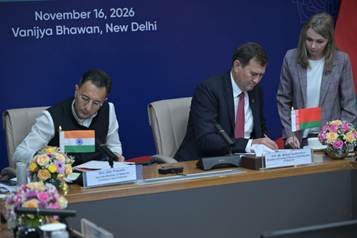
November 17: India and Belarus reviewed a proposed cooperation roadmap and signed a commission protocol in New Delhi on November 16, while their scientific institutions renewed plans for joint research. Separate Commerce Ministry and science-agency accounts show a combination of business outreach and institutional follow-up.
Key highlights
- The inter-governmental commission discussed a 2027–2031 economic-cooperation roadmap.
- A business forum explored manufacturing, technology and investment opportunities.
- CSIR and Belarus’s science academy propose a second joint research call from November 27.
What the economic talks covered
Minister of State Jitin Prasada and Belarusian Foreign Minister Maxim Ryzhenkov co-chaired the twelfth inter-governmental commission. India’s Commerce Ministry said the discussions included industry, banking, agriculture, pharmaceuticals, customs and scientific cooperation.
The ministry also described a parallel business forum and interest in joint ventures, technology transfer and localisation. It identified potential opportunities in machinery, mining equipment, water treatment and food processing. These are areas for business exploration, not a list of completed investments.
A separate scientific workstream
The science ministry said CSIR and the National Academy of Sciences of Belarus signed a second programme of cooperation. It builds on their May 2023 memorandum and an earlier research call that resulted in seven approved joint projects.
The institutions propose opening another research, development and innovation call from November 27. The announcement signals a planned opportunity for researchers; it does not itself provide a complete application package or establish that submissions are already open.
What researchers and businesses need next
For a research team, the decisive information will be the published call: eligible institutions, priority fields, funding arrangements, submission routes and deadlines. The science release gives inconsistent end-years for the cooperation programme in different paragraphs, so the final call and signed programme should govern any planning that depends on its duration.
For a business, an inter-governmental roadmap can identify channels for engagement but does not replace project-level due diligence. Commercial terms, applicable rules, technical standards and counterparties still have to be checked for each proposed transaction. A forum discussion is not evidence of a signed supply contract.
How to measure whether the talks deliver
Our assessment is that the useful test will be identifiable follow-through: a published research call, named institutional partnerships and projects that progress beyond expressions of interest. Keeping economic and scientific announcements distinct also prevents a proposed research programme from being described as a commercial investment already delivered.
At a glance
| Workstream | Reported development |
| Economic commission | Protocol signed; roadmap discussed |
| Roadmap horizon | 2027–2031 in the Commerce Ministry account |
| Earlier scientific call | Seven joint projects approved |
| Next scientific call | Proposed from November 27; final rules awaited |
What to watch
Watch CSIR and NASB for the actual research-call documents and the relevant ministries for specific commercial outcomes. Programme duration and application conditions should be checked against final official documents.
Sources
- India Commerce Ministry: Twelfth India–Belarus inter-governmental commission
- CSIR / India Science Ministry: Renewed scientific partnership with NASB

The Business Desk covers markets, the economy, companies and personal finance. Stories are checked against at least two credible sources before publication.