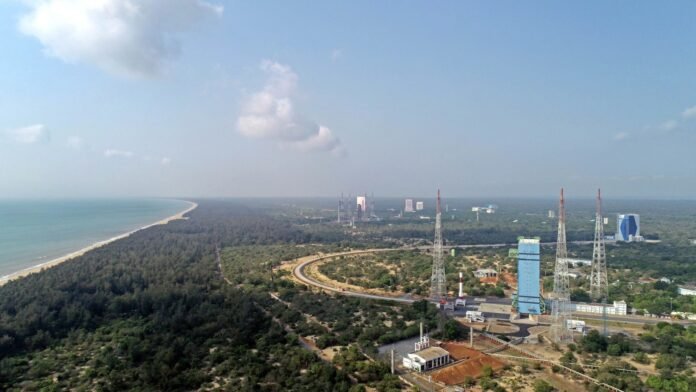
October 25: India’s launch-infrastructure expansion involves two distinct projects: a third pad at Sriharikota in Andhra Pradesh and a separate Small Satellite Launch Vehicle complex at Kulasekarapattinam in Tamil Nadu. Together with Sriharikota’s two existing pads, these explain the four-pad plan. Official documents describe different purposes and target dates; they do not say four pads are already operational.
Key highlights
- Sriharikota’s First and Second Launch Pads are the operational facilities identified in the Department of Space’s March 2026 parliamentary answer.
- The approved Third Launch Pad is intended for heavier next-generation vehicles and backup capability.
- Kulasekarapattinam is a separate site focused on SSLV launches towards sun-synchronous polar orbit.
- Government documents use target timeframes rather than a guarantee that every facility will open on the same date.
Two sites, different roles
The Department of Space’s March 18, 2026 parliamentary answer, published by PIB, says the First Launch Pad supports PSLV and SSLV, while the Second supports PSLV, GSLV and LVM3. Both are at Satish Dhawan Space Centre, Sriharikota.
The answer places the Third Launch Pad’s establishment in the 2029–30 timeframe and the Tamil Nadu SSLV site’s commissioning in financial year 2026–27. A financial-year target is not the same thing as a specific launch date. Neither statement is a commissioning certificate.
| Facility | Location | Role or status in official records |
|---|---|---|
| First Launch Pad | Sriharikota | Operational; PSLV and SSLV |
| Second Launch Pad | Sriharikota | Operational; PSLV, GSLV and LVM3 |
| Third Launch Pad | Sriharikota | Approved project; next-generation launch capability |
| SSLV Launch Complex | Kulasekarapattinam | Separate site being established for small-satellite launches |
Our calculation: Two existing pads plus the planned Third Launch Pad and the separate SSLV facility make four principal facilities in this comparison. This is a count of the facilities discussed here, not a claim that every private or suborbital launch installation in India is included.
What the Third Launch Pad approval actually covers
ISRO’s January 16, 2025 announcement records Cabinet approval for the project, with a total requirement of ₹3,984.86 crore for the pad and associated facilities. It describes an adaptable design for Next Generation Launch Vehicles, LVM3 with a semi-cryogenic stage and larger NGLV configurations. It also identifies a standby role for the Second Launch Pad.
The announcement sets an intended implementation duration of four years and envisages substantial industry participation while sharing existing facilities. Its longer-term purpose includes supporting higher launch frequency and human-spaceflight capability. These are the approved objectives, not a statement that each future mission has been assigned a completed launch pad.
A pad’s usefulness depends on its compatibility with the vehicle and mission. Counting facilities alone does not tell a customer how soon a particular satellite can fly: the rocket, payload readiness, range availability and mission approvals also have to align. More infrastructure creates options; it does not remove every other scheduling constraint.
Why Parliament wants infrastructure diversified
The parliamentary standing committee’s March 17, 2026 press release on Department of Space demands for grants raises the operational risk of depending on a limited number of pads. It notes the age of the existing Sriharikota facilities and calls for strengthening and diversifying launch infrastructure as the programme expands.
The committee also refers to the Third Launch Pad’s expected 2029–30 readiness. That is legislative scrutiny of the programme’s resilience, separate from ISRO’s original Cabinet announcement. It helps explain why the discussion is about backup capability and reliability as well as a larger headline number.
How to read the timeline
Project approval, civil construction, installation, testing and commissioning are different milestones. A building or tower appearing complete in a photograph does not prove that all systems have been qualified for launch. Equally, an approved budget is not evidence that the full amount has already been spent.
The published documents come from different dates and use different reporting conventions. The safest interpretation is to retain each date and timeframe, rather than compressing them into a single guaranteed opening day. Fresh commissioning announcements would be needed to establish that a planned facility has entered service.
What to watch next
For Kulasekarapattinam, the decisive update will be a dated official commissioning or launch-readiness announcement. For the Third Launch Pad, watch documented construction and systems milestones and any revised government schedule. Specific customer launches and private-company contracts should be reported only when separately confirmed.
The practical significance is a broader launch base with specialised small-satellite capacity and provision for larger future vehicles. The official record supports that direction. It does not support describing all four facilities as finished today or treating the headline target as a promise that delays are impossible.
File photo: Sriharikota during PSLV-C55/TeLEOS-2 preparations, April 19, 2023. Photo: Indian Space Research Organisation, via Wikimedia Commons. Resized; this is not the planned Third Launch Pad. Photo source and GODL-India details; ISRO reuse policy.
Sources
- Department of Space / PIB: Parliamentary answer on satellite launch facilities, March 18, 2026
- ISRO: Cabinet approval of the Third Launch Pad, January 16, 2025
- Parliamentary standing committee: Department of Space demands for grants, March 17, 2026

The Tech Desk covers technology, artificial intelligence and cybersecurity. Stories are checked against at least two credible sources before publication.