Update: Later on September 8, Mayor Vitali Klitschko put the number of injured at 10, and said at least 14 high-rise buildings, a dormitory, a school and a clinic were damaged. Russia’s defence ministry said it had struck military and logistics targets in and around Kyiv and the Black Sea port of Chornomorsk. For what followed, see our reports on Russian strikes that injured 19 in the Kyiv region on September 18 and the Zelenskyy–Trump meeting agreed for New York.
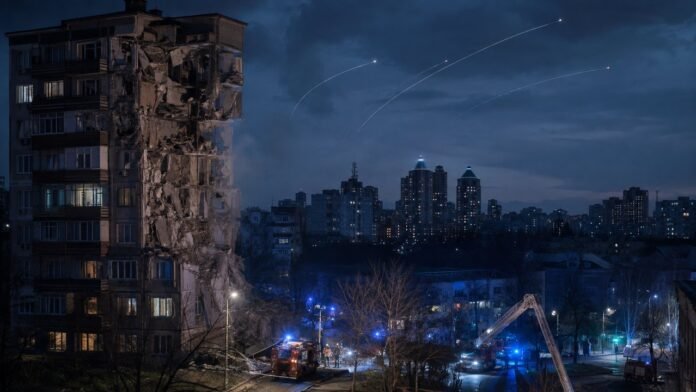
Kyiv/New Delhi, September 8: Russian ballistic missiles struck Kyiv early on Tuesday, Ukrainian officials said. By 6:30 a.m. local time, the official update put the toll at two dead and seven injured. Mayor Vitali Klitschko had earlier said people were trapped in a residential building and that fires had broken out in several places; rescuers later said 13 people had been brought out. The attack came shortly after US peace envoys Steve Witkoff and Jared Kushner left Kyiv.
The mayor’s first figure was six injured. The Kyiv City Military Administration later revised the figure to two dead and seven injured as of 6:30 a.m. The numbers could still change, and not every detail of the attack could be independently verified, so they should not be treated as final.
Key highlights
- Explosions were heard in the capital before dawn, and residents were told to stay in shelters.
- City officials reported two dead and seven injured as of 6:30 a.m.
- Falling debris damaged a five-storey apartment building and a three-storey residential block, the Kyiv City Military Administration said.
- Kyiv’s emergency service said 13 people were rescued from damaged buildings.
- Neighbouring Poland activated military aviation operations to protect its airspace.
How the figures changed
| Source | When | What it reported |
|---|---|---|
| Mayor Vitali Klitschko | Early morning | Six injured; people trapped in a residential building; fires in several places |
| Kyiv City Military Administration | By 6:30 a.m. | Two dead, seven injured; debris damaged a five-storey and a three-storey residential building |
| Kyiv emergency service | Morning | 13 people rescued from affected buildings |
Unverified casualty figures and missile counts circulating on social media have been left out of this report while rescue work and damage assessment continue.
An attack straight after the envoys’ visit
The timing gave the attack extra diplomatic weight. Witkoff and Kushner met Ukrainian President Volodymyr Zelenskyy on Sunday, after earlier talks in Moscow with Russian President Vladimir Putin, as part of the Trump administration’s renewed push to end the war.
A pause in strikes on both capitals during the envoys’ visit lasted until Monday, but no wider ceasefire or formal breakthrough was announced. The Kremlin had not ruled out a return to three-way talks, but the core demands of Moscow and Kyiv remain far apart. A strike on the capital right after the envoys left shows that diplomatic contact and battlefield escalation can run side by side.
Has Russia responded?
Early accounts carried no detailed Russian response, and the missile type and launch site had not been independently confirmed. Ukrainian officials described it as a Russian ballistic missile strike, and early accounts were based on those official statements. Both sides have made competing claims throughout the war; independent visual verification and emergency records will give a more reliable picture.
Drone attack in Russia’s Saratov region
The same night, the governor of Russia’s Saratov region said Ukrainian drones had damaged civilian infrastructure and injured people. Saratov lies on the Volga about 730 km south-east of Moscow and is home to a large Rosneft oil refinery as well as other industrial and military sites. The governor’s early statement gave no full details of injuries or damage. Together, the Kyiv and Saratov incidents show that long-range drone and missile attacks are continuing in both directions.
Pressure on Kyiv’s air defences
Stopping ballistic missiles requires fast detection and specialised interceptors. Repeated alarms, interception attempts and falling debris endanger residential areas even when a missile does not hit a building directly, which is why Ukraine keeps asking for more air-defence missiles and radar support. Wider pressure on European security was also visible in the suspected drone incident at Leipzig/Halle Airport, although there is no evidence linking the German case to the Kyiv attack.
What it means for India and Asia
India has kept ties with both Russia and Ukraine while calling for dialogue and diplomacy. Any new escalation makes peace efforts harder and adds risk to energy, fertiliser, grain and shipping markets. That does not mean a single attack will move prices in a set way; the effect depends on how long the conflict lasts, on supply routes and on how markets react. The war’s financial cost also keeps rising: our report on Ukraine’s EU funding plan explains how battlefield pressure feeds into budgets and allied support.
What to watch
- The next casualty and damage report from Kyiv’s emergency services.
- The Ukrainian Air Force’s missile count, debris analysis and any Russian military statement.
- Whether Poland says its airspace was actually violated or its operation was only precautionary.
- Whether Witkoff and Kushner put forward a concrete proposal after their Moscow and Kyiv meetings.
This article was first published in Hindi and has been translated. The Press of Asia now publishes in English only.
Sources
- Kyiv City Military Administration: updated casualty report (Telegram)
- Kyiv emergency service: rescue update (Telegram)

The International Desk covers world and Asian affairs, diplomacy and conflict, with a focus on what they mean for India. Stories are checked against at least two credible sources before publication.