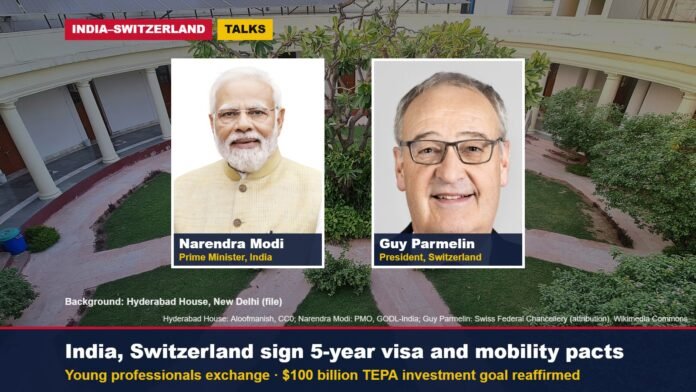
October 5: Prime Minister Narendra Modi and Swiss President Guy Parmelin held delegation-level talks at Hyderabad House in New Delhi on Monday. The two countries signed a Migration and Mobility Partnership and an agreement on exchanging young professionals, which include multiple-entry visas valid for up to five years. Modi said the India–EFTA trade agreement would bring $100 billion of investment and one million direct jobs over the next 15 years.
Key highlights
- Visas: the mobility agreement provides for multiple-entry visas valid for up to five years and one-year renewable student permits.
- Young professionals: 300 young professionals from each country will be exchanged every year, a number that can rise to 500.
- Investment: the goal of $100 billion in investment and one million direct jobs over 15 years is linked to the India–EFTA agreement (TEPA).
- New areas: cooperation in defence production, nuclear energy, AI, transport technology and research was discussed.
- Visit: President Parmelin is on a state visit to India from October 5 to 7.
What was agreed
The two sides concluded the following agreements and documents:
| Agreement | What it covers |
|---|---|
| Migration and Mobility Partnership (MMP) | Multiple-entry visas valid for up to 5 years; one-year renewable student permits; arrangements for job opportunities for young people |
| Young professionals exchange agreement | 300 young professionals from each country every year; can rise to 500 |
| MoU on transport technology, mobility systems and infrastructure | Cooperation on electric vehicles, ropeways, the circular economy and tunnel construction |
| Letter of Intent: India’s Department of Science and Technology and the Swiss National Science Foundation | Long-term joint research |
| Implementing arrangement: Department of Science and Technology and Zurich University of Applied Sciences | An Indo-Swiss academia–industry training programme for early-stage start-ups |
The mobility agreement also sets a timeline of 30 to 90 days for verifying citizenship and residence status. External Affairs Ministry spokesperson Randhir Jaiswal also mentioned joint research initiatives in health, clean energy and space.
What Prime Minister Modi said
In his statement after the talks, the Prime Minister said the India–EFTA Trade and Economic Partnership Agreement (TEPA) is India’s first free trade agreement with a European economic bloc, and a blueprint for investment, innovation, jobs and shared prosperity. He said it would bring $100 billion of investment and one million direct jobs to India over the next 15 years.
India wants to raise exports of farm goods, pharmaceuticals, textiles and engineering goods, while it hopes for investment from Swiss companies in biotech, life sciences, banking, insurance, food processing and sustainability. The Prime Minister also spoke of expanding cooperation in military exchanges, defence production and nuclear energy.
On global issues, the Prime Minister said India and Switzerland both believe in democratic values, the rule of law, dialogue and diplomacy, and both believe reform of global institutions is essential to deal with growing challenges. He said that whether in Ukraine or West Asia, India has consistently supported every meaningful effort for peace.
What President Parmelin said
President Parmelin said his visit was a step towards deepening the two countries’ long-standing and wide-ranging partnership, which rests on shared democratic values, trust and mutual respect. He also said companies’ interest in TEPA had been very strong since it came into force. AI cooperation was also discussed; Switzerland will host a global AI summit in Geneva in 2027.
What TEPA is, and where the $100 billion figure comes from
EFTA is a group of four European countries: Iceland, Liechtenstein, Norway and Switzerland. The India–EFTA agreement, TEPA, has been in force since October 1, 2025. According to the External Affairs Ministry, Switzerland is India’s largest trade and investment partner among the EFTA countries. The $100 billion investment and one million jobs figure is a 15-year goal linked to this agreement.
| Item | Detail |
|---|---|
| EFTA members | Iceland, Liechtenstein, Norway, Switzerland |
| TEPA in force since | October 1, 2025 |
| Investment goal | $100 billion over 15 years |
| Jobs goal | One million direct jobs |
| By our calculation | An average of about $6.7 billion a year if spread evenly over 15 years |
The rest of the visit
This is President Parmelin’s first state visit to India. He was also in New Delhi in February this year for the AI Impact Summit. On Monday he paid tribute at Rajghat, and President Droupadi Murmu and Prime Minister Modi gave him a ceremonial welcome at Rashtrapati Bhavan. External Affairs Minister S. Jaishankar also called on him. The programme includes a state banquet hosted by President Murmu. On October 7, President Parmelin will attend the second India–EFTA Prosperity Summit, held on TEPA’s first anniversary.
What to watch
- Details at the India–EFTA Prosperity Summit on October 7.
- When the mobility partnership and the young professionals scheme start operating.
- How much investment actually arrives under TEPA in the coming years.
What it means
Monday’s concrete outcome is the visa and mobility agreements, which will directly affect students, researchers and young professionals. The $100 billion figure is not a new announcement; it is TEPA’s 15-year goal, so the real test is how much investment actually materialises in the years ahead. More details may come out at the October 7 summit.
This article was first published in Hindi and has been translated. Statements by the Prime Minister and the President are paraphrased from English-language reports. The Press of Asia now publishes in English only.

The International Desk covers world and Asian affairs, diplomacy and conflict, with a focus on what they mean for India. Stories are checked against at least two credible sources before publication.