November 1: India’s Education Ministry has extended the 2026–27 National Means-cum-Merit Scholarship Scheme application deadline to November 15, 2026. Its October 31 announcement also sets separate later deadlines for institute and district verification, which students should track after submitting their forms.
Key highlights
- Student applications close on November 15, 2026.
- Institute Nodal Officer verification closes on November 30.
- District Nodal Officer verification closes on December 15.
- Eligible students receive ₹12,000 a year; selection and renewal requirements still apply.
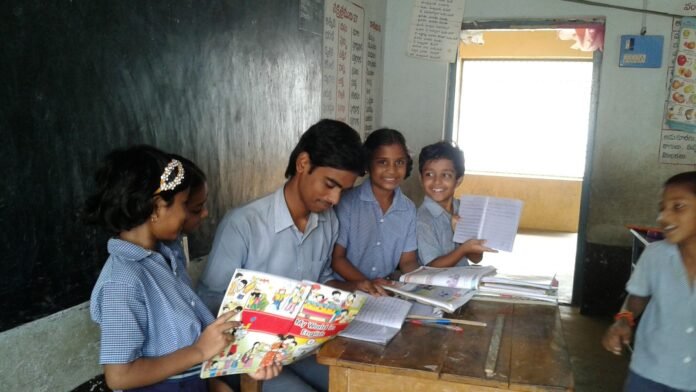
File photo: students at a government school in South India (July 17, 2015). Photo: Sahajmindsindia / Wikimedia Commons, CC BY 4.0. Cropped and resized by The Press of Asia. Used to illustrate school education; the pictured pupils are not identified as NMMSS recipients.
The revised schedule
| Process | Last date |
|---|---|
| Student application submission | November 15, 2026 |
| Institute Nodal Officer verification — L1 | November 30, 2026 |
| District Nodal Officer verification — L2 | December 15, 2026 |
The ministry says the extension gives eligible students more time to complete applications on the National Scholarship Portal. Students who have already submitted should ensure that the responsible officials complete both verification stages. Submission and approval are separate steps.
The National Scholarship Portal hosts several scholarships, each with its own dates. Applicants should use the scheme-specific NMMSS schedule when checking their next step. A deadline displayed for another programme does not replace the revised NMMSS dates.
Who the scheme is intended to support
The ministry describes NMMSS as support for meritorious students from economically weaker sections to continue beyond Class VIII. It provides one lakh fresh scholarships annually for eligible Class IX students who qualify in state or union-territory selection examinations. Renewal through Classes X–XII is subject to academic requirements.
Its release identifies state-government, government-aided and local-self-government schools as eligible school types. It gives an annual parental-income ceiling of ₹3.50 lakh and a Class VII selection-test threshold of 55%, with a five-percentage-point relaxation for SC/ST students.
Those conditions concern eligibility and selection; an extended application window does not waive them. A family should therefore check the student’s actual selection status and scheme requirements before assuming that filling out an online form creates an entitlement.
OTR and the application are different tasks
The National Scholarship Portal says One-Time Registration is a 14-digit number based on Aadhaar or Aadhaar Enrolment ID and is intended to remain valid throughout a student’s academic career. OTR is required to apply, but obtaining the number does not itself submit an NMMSS application.
A practical sequence is to check or complete OTR, select the correct scheme and academic year, review the entered details, submit the application, and retain the acknowledgement. Students should then monitor the verification status and respond promptly if their school identifies an error.
The portal also lists scholarship assistance at Common Service Centres. Its published charge for the full candidate activity, including OTR-related work and application filing, is ₹30 inclusive of applicable taxes. Readers should distinguish this assistance charge from the scholarship itself; it is not a payment that guarantees selection.
What already-submitted applicants should do
Keep the application reference and contact the school’s nodal officer if verification remains pending. Ask which stage has been completed and whether anything needs to be corrected, rather than submitting a duplicate form simply because the deadline has moved.
Check that the academic year and the fresh-or-renewal category match the student’s position. A renewal applicant is continuing an existing award under the relevant requirements; a fresh applicant is entering through the selection process. Confusing the two can create an avoidable processing problem.
What to watch next
The immediate deadline is November 15, followed by the two verification cut-offs. The ministry’s release says payments are made through direct benefit transfer. It does not announce a universal payment date for every applicant.
Use the official portal and the responsible school or district officials for case-specific status. The extension is useful additional time, but eligibility, complete information and timely verification remain the steps that matter.
Sources
- Education Ministry via PIB: NMMSS application deadline extended to November 15, 2026
- National Scholarship Portal: OTR, student services and application information

The National Desk covers India's politics, governance, security and public-interest news. Stories are checked against at least two credible sources before publication.