October 30: India has constituted the National Social Security Board through a Labour Ministry notification published in the Official Gazette on October 29. The notice also specifies a different composition when the same Board addresses gig and platform workers, bringing aggregators and worker organisations into that forum.
Key highlights
- The notification is S.O. 5884(E), dated October 28.
- The Board’s stated term is three years from Gazette publication.
- The Union Labour Minister chairs the Board.
- Constitution of the Board is distinct from a benefit-scheme notification.
How gig-worker representation is arranged
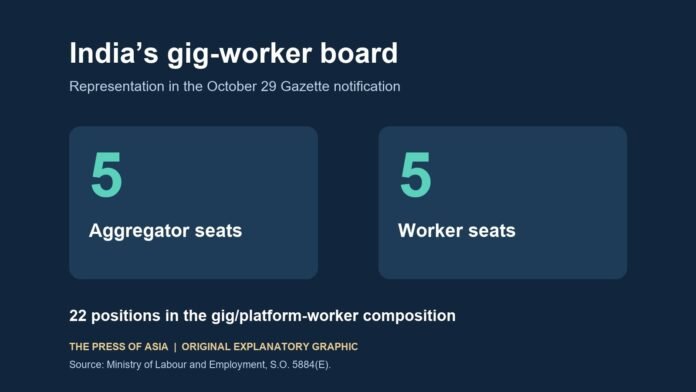
For gig and platform-worker matters, the notice names representatives of Eternal Group, Swiggy, Zepto, Urban Company and Rapido. Five worker seats are allocated across IFAT, BMS, NFITU and TUCC, with IFAT receiving two.
| Part of the gig/platform composition | Number of positions |
|---|---|
| Chair and Vice-Chair | 2 |
| Aggregator representatives | 5 |
| Worker representatives | 5 |
| ESIC and EPFO heads | 2 |
| Research and education institutions | 2 |
| State government representatives | 5 |
| Member-Secretary | 1 |
Our calculation: these categories total 22 positions in the gig/platform-worker composition. The five aggregator seats and five worker seats are parts of that total, rather than the whole Board.
What the Social Security Code provides
Section 6 of the Code on Social Security, 2020 provides for the National Board and sets out functions including recommending suitable schemes, advising the government and monitoring specified welfare schemes. Section 114 addresses schemes for gig and platform workers and the Board’s corresponding composition.
The Code identifies possible scheme areas including life and disability cover, accident insurance, health and maternity benefits, and old-age protection. A statutory power to frame schemes and the terms of a particular notified scheme are separate legal steps.
This distinction matters to an individual worker. Knowing that a category is included in legislation does not, by itself, identify a benefit amount, the insurer or administrator, an eligibility decision or an application deadline. Those details must come from the applicable operational scheme and its current rules.
What this Gazette notice actually changes
The notice identifies the institution’s members and its composition for different responsibilities. It does not set a universal cash payment, announce automatic EPF or ESI coverage for every platform worker or supply a new public application portal.
For aggregators and worker organisations, the membership creates identifiable representation within the announced structure. Whether that produces a particular recommendation, approved scheme or improvement in coverage will depend on subsequent decisions and implementation records.
Those outcomes should be followed through dated documents. A meeting agenda, a recommendation, a government decision and a benefit delivered to a worker are different points in that sequence. Reporting them separately makes it possible to assess what has actually happened.
What workers and readers should look for next
The most useful next records would specify which schemes are considered, which categories of workers they cover, how they are funded and how eligibility is established. Practical access also requires a clear administrator, claims process and route for addressing problems.
Until those records are available for a particular benefit, the confirmed news is the Board’s constitution and representation. Readers should not treat an unofficial payment claim or registration message as part of this notification merely because it mentions the new Board.
What to watch
Further Labour Ministry and Gazette publications will establish any additional scheme decisions. The accompanying diagram is an original explanation of the representation stated in the notice; it is not a government identity document or an application form.
Sources
- Government of India Gazette: S.O. 5884(E), National Social Security Board, published October 29, 2026
- India Code: Code on Social Security, 2020, sections 6 and 114

The Business Desk covers markets, the economy, companies and personal finance. Stories are checked against at least two credible sources before publication.