October 30: South Korea’s all-industry production rose 3.0% in September from the previous month, official figures released today show. Retail sales and equipment investment also increased, although the annual comparisons remained mixed, making the monthly rebound an incomplete measure of the broader recovery.
Key highlights
- The report covers September activity and was released on October 30.
- Manufacturing production rose 9.9% month on month.
- Retail sales increased from August but remained below a year earlier.
- Monthly and annual rates need to retain their separate labels.
The main indicators side by side
| Official indicator | Month on month | Year on year |
|---|---|---|
| All-industry production | +3.0% | +1.1% |
| Manufacturing production | +9.9% | +1.6% |
| Retail sales | +3.6% | −0.4% |
| Equipment investment | +5.3% | +10.1% |
| Completed construction, real terms | +5.8% | −1.6% |
The Ministry of Data and Statistics also reported manufacturing shipments up 6.3% from August and inventories up 0.8%. From a year earlier, those measures were down 1.2% and up 7.0%, respectively.
How sales can rise monthly and fall annually
A monthly increase compares September with August. An annual change compares September with the same month of the previous year. The two starting points differ, so the signs need not match.
The retail readings illustrate the point: spending can recover from the immediately preceding month without returning to the level recorded a year earlier. The monthly improvement is meaningful, but it does not erase the annual shortfall.
For a retailer assessing demand, a useful follow-up would connect the aggregate readings to its product category, sales volumes and comparison period. The national total cannot establish the experience of every store or household.
Manufacturing output and capacity use
The average manufacturing capacity-utilisation rate reached 76.8%, up 5.6 percentage points from August, according to the release. This actual utilisation rate is a different measure from the separately reported utilisation index.
An index describes movement relative to a base, while a utilisation percentage describes the measured use of capacity. Substituting the change in one for the other would produce a misleading description of factory activity.
Production, shipments and inventories also have different denominators. Their growth rates should not be subtracted to calculate a physical quantity of unsold goods. The separate figures help frame questions about demand and stocks, but answering those questions requires the underlying industry and product detail.
Investment is an additional signal, not a substitute for consumption
Equipment investment concerns spending on productive assets. Retail sales concern consumer purchases. One can strengthen before the other, and their percentage changes cannot be averaged into a meaningful overall recovery rate without a consistent weighting framework.
The construction readings offer another reason to preserve both time comparisons: the monthly increase coexists with a lower real level than a year earlier. A positive monthly number does not imply that the sector has regained its previous annual position.
For readers following Asian production chains, the report identifies a stronger month of Korean activity. It does not disclose a particular company’s orders or establish the country destination of additional output. Those require separate company and trade records.
What to watch
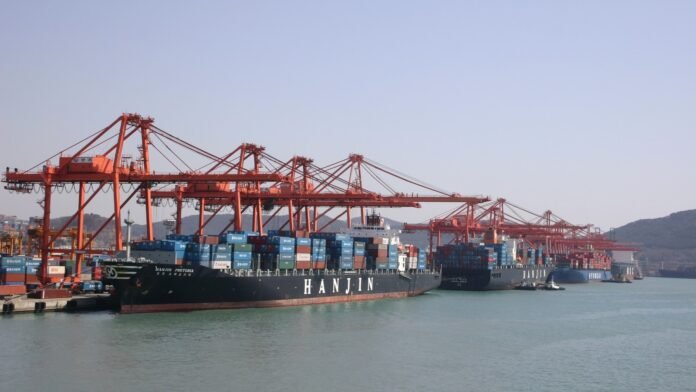
Subsequent production, shipment and retail releases will show whether the improvement continues across more than one month. A durable assessment should combine output with demand and stock movements, while keeping revised data and comparison periods clear. The accompanying image is a licensed archival photograph of Busan Container Terminal.
Sources

The Business Desk covers markets, the economy, companies and personal finance. Stories are checked against at least two credible sources before publication.