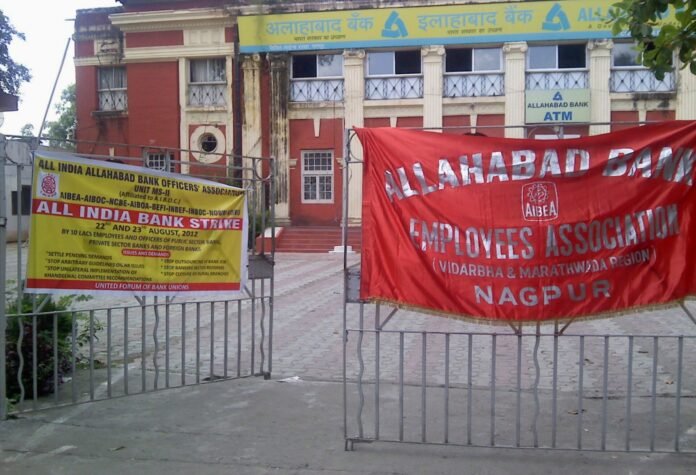
New Delhi, September 27: If you need to get something done at a bank branch, the next few days could be difficult. The United Forum of Bank Unions (UFBU), the joint platform of bank unions, has called a nationwide strike on September 28, 29 and 30, and the unions have not backed down despite appeals from the government and bank managements. Banks were closed on September 26 for the fourth Saturday of the month and September 27 is a Sunday, so normal work at many branches could be halted for five days in a row.
Update (September 28): This strike has now been deferred. Read the latest: Bank strike deferred after late-night IBA–UFBU agreement
Update (October 13): The UPI merchant fee (MDR) on merchant payments above ₹2,000, mentioned below as due on October 15, has been deferred until after Diwali, with a new date to be notified. Read: UPI merchant fee rollout deferred until after Diwali
Key highlights
- Strike dates: September 28 to 30 (Monday to Wednesday).
- Main demands: a five-day banking week (every Saturday off) and withdrawal of the performance-linked incentive (PLI) scheme.
- Who is involved: employees of public sector banks and regional rural banks; about 8 lakh bank staff, according to reports.
- Will work: UPI, mobile banking, internet banking and ATMs (as long as cash lasts).
- Will be affected: cash deposits and withdrawals at branches, cheque clearing, drafts and loan work.
Why the strike is happening
The unions’ biggest demand is a five-day banking week. At present banks are closed on the second and fourth Saturdays of the month. According to ETV Bharat, employees are willing to work about 40 minutes more each day in return for every Saturday off. The unions say this was agreed between the Indian Banks’ Association (IBA) and the UFBU on March 8, 2024, but about two and a half years later the government notification has still not come.
The second demand is the withdrawal of the PLI scheme. The unions argue that the scheme creates inequality between staff at different levels and that the work of bank employees who implement government schemes is not properly recognised.
What happened in the talks
According to Business Standard, a conciliation meeting was set for September 23 to avert the strike, but earlier talks produced no concrete result. The Department of Financial Services (DFS) and the finance ministry say the five-day banking week is under consideration and needs the views of all stakeholders. The ministry also said strikes disrupt work and do not lead to a meaningful solution.
UFBU leader C.H. Venkatachalam has said a three-day bank strike is a big issue in a country like India, but the problem is not being solved. According to reports up to September 26, the strike decision stands. The unions also held a one-day strike on September 11, and have warned of an indefinite strike from October 26 if their demands are not met.
What banks told customers
SBI has advised customers to use digital channels such as ATMs/ADWMs, customer service points (CSPs), YONO, internet and mobile banking and UPI during this period. Indian Bank has also said services may be affected and asked customers to use mobile banking, ATMs and digital channels. Bank of India, Punjab National Bank and Bank of Baroda have appealed to their employees not to join the strike.
What will work and what will not
| Service | Status |
|---|---|
| UPI, mobile and internet banking | Working normally |
| ATMs | Working, but cash may run out in places if refilling is delayed |
| Cash deposits/withdrawals at branches | Affected |
| Cheque clearing | Affected; payments may be delayed |
| Drafts, RTGS forms and loan approvals at branches | Affected |
The strike is mainly in public sector banks and regional rural banks; some reports say staff at a few older private banks may also join. So check whether your branch will be open through your bank’s SMS, website or customer care.
Advice for customers
- Cash: withdraw the cash you need today; ATMs may run short from Monday.
- Cheques: instead of giving cheques for rent, fees or other payments, transfer by UPI or net banking.
- Businesses: plan month-end payments, salaries and GST in advance.
- Beware of fraud: never share an OTP, PIN or password on calls or messages such as “update your account during the strike”.
With more reliance on digital payments, also note that an MDR rule on merchant UPI payments above ₹2,000 was due from October 15 (since deferred; see the update above). For salaried people, recent PF changes are also worth knowing (EPFO wage ceiling of ₹25,000).
What to watch
- If the strike goes ahead, pressure on branches at month-end, when salaries, EMIs and business payments peak, with crowds likely on October 1.
- When and what the government decides on the five-day banking week.
- The threatened indefinite strike from October 26, which would have a much bigger impact.
What it means
With the fourth-Saturday holiday and Sunday before it, many branches could stay shut for five days in a row, from September 26 to 30, right at month-end. Digital channels will keep most payments moving, but branch-dependent customers, especially older people and small businesses that rely on cash and cheques, would be hit hardest.
This article was first published in Hindi and has been translated. The Press of Asia now publishes in English only.
Sources
- Business Standard: Bank unions to go ahead with 3-day strike despite govt, management appeals
- The Tribune: Banks brace for 5-day disruption from September 26
- ETV Bharat (Hindi): Banks to stay shut for 3 days from September 28

The Business Desk covers markets, the economy, companies and personal finance. Stories are checked against at least two credible sources before publication.