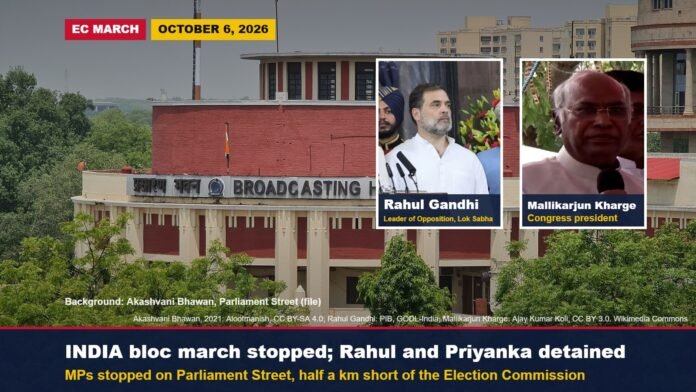
October 6: Delhi Police on Tuesday stopped the opposition INDIA bloc MPs’ march, held to demand the removal of Chief Election Commissioner (CEC) Gyanesh Kumar, before it could reach Nirvachan Sadan, the Election Commission’s headquarters. Leader of the Opposition in the Lok Sabha Rahul Gandhi and Congress MP Priyanka Gandhi Vadra were detained. Congress president Mallikarjun Kharge said the fight would go on. The BJP dismissed the march.
Update (October 7): After the march was stopped, Rahul Gandhi and Priyanka Gandhi Vadra sat on a dharna for hours at Akashvani Bhawan. At night police removed them to Kingsway Camp and later let them go. The full sequence and every side’s statements: Rahul Gandhi removed from Akashvani Bhawan.
Key highlights
- Where it was stopped: on Parliament Street, near NITI Aayog and Akashvani Bhawan. The spot is about half a kilometre short of the Commission’s office.
- Detained: Rahul Gandhi and Priyanka Gandhi Vadra. Also Akhilesh Yadav, Abhishek Banerjee and Derek O’Brien.
- How many MPs: 237 MPs from 19 parties; about 300.
- Security: More than 4,000 personnel were deployed and Section 163 was in force in the New Delhi district.
- BJP: Union minister Shivraj Singh Chouhan called the march an attempt to “relaunch” Rahul Gandhi.
What happened on the march
The MPs set out from Parliament’s Makar Dwar towards Nirvachan Sadan, but police stopped them with barricades near the NITI Aayog office. The march halted near Akashvani Bhawan on Parliament Street. Rahul Gandhi climbed the barricade holding the tricolour, after which police began clearing the protest and detained Rahul Gandhi, Priyanka Gandhi Vadra and other leaders.
The MPs were put on buses and taken away. Trinamool Congress MP Sagarika Ghose said the MPs were being taken to an “unknown location”. Rahul and Priyanka Gandhi were held briefly, and NSUI and Youth Congress workers were also picked up.
Where the reports differ
| Point | Public record | Public record |
|---|---|---|
| Number of MPs | 237 MPs from 19 parties | About 300 MPs from the Lok Sabha and Rajya Sabha |
| Where the march stopped | Near Akashvani Bhawan on Parliament Street | Near the NITI Aayog office |
| Who joined | DMK and AAP stayed away; the Biju Janata Dal, not formally in the alliance, joined | Not specified |
| Others detained | MPs taken away in buses | Akhilesh Yadav, Abhishek Banerjee, Derek O’Brien; NSUI and Youth Congress workers |
What the leaders said
Rahul Gandhi said Gyanesh Kumar should now resign. He said crores of people had voted for the opposition, so why was the Commission not talking to them.
Mallikarjun Kharge said this was a fight and the opposition would keep fighting. He said the protest would continue and was about protecting people’s votes and freedom. Samajwadi Party president Akhilesh Yadav said BJP people were scared, which was why barricades had been put up. Shiv Sena (UBT) MP Sanjay Raut asked why such a large force was needed to stop MPs.
Police arrangements
More than 4,000 personnel of the Delhi Police and the Central Armed Police Forces were deployed, with barricades in several layers. Prohibitory orders under Section 163 of the Bharatiya Nagarik Suraksha Sanhita (BNSS) were in force in the New Delhi district, with restrictions on movement from 8 am around Connaught Place, Parliament Street, Patel Chowk, the GPO and Ashoka Road.
The BJP’s and the Election Commission’s side
Union Agriculture Minister Shivraj Singh Chouhan dismissed the march. He said the revision of voter rolls was necessary to remove the names of dead, duplicate and shifted voters. He called the march an attempt to “relaunch” Rahul Gandhi and spread anarchy. The Election Commission has denied the allegations of irregularities.
What is happening in the courts
The Supreme Court refused on October 5 to pass an interim order against the CEC. Chief Justice Surya Kant said the court had not approved any change to Form 6 for voter enrolment. The Bombay High Court also asked what the purpose of the whole Special Intensive Revision (SIR) exercise was if citizens themselves were being left off the rolls.
What to watch
- The INDIA bloc is seeking time to meet the President in the second week of October.
- Five rallies are planned, including one in Delhi on November 1.
- The protests have been running since October 2; Tuesday was the fifth day.
- Further hearings on the petitions against the CEC in the Supreme Court.
What it means
By stopping the march half a kilometre short of the Election Commission, police kept the confrontation on the street rather than at the Commission’s door. For the opposition, the pictures of its leaders on a barricade and in police buses are part of the message. For the BJP and the Commission, the argument is that the voter-roll revision is a routine clean-up of dead and duplicate names. With the Supreme Court declining interim relief but keeping the petitions alive, the dispute now runs on two tracks: street protests and the courtroom. The background, the allegations and the constitutional process for removing a CEC are in our morning report: the INDIA bloc’s march to the Election Commission.
This article was first published in Hindi and has been translated. Leaders’ statements from English-language reports are paraphrased. The Press of Asia now publishes in English only.

The National Desk covers India's politics, governance, security and public-interest news. Stories are checked against at least two credible sources before publication.