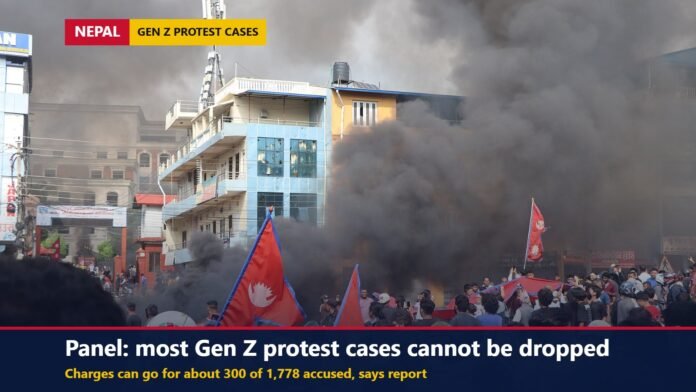
October 7: A committee set up by Nepal’s government has concluded that charges can be withdrawn for only about 300 of the 1,778 people named in 445 cases over the Gen Z protests of September 2025, The Kathmandu Post reported. Most of the accused face allegations such as murder, arson and looting, which existing law does not allow the state to drop, the panel found. Government spokesperson Sasmit Pokharel said on Monday that the Cabinet had decided to send the report to the Ministry of Home Affairs for implementation. Protest leaders say the outcome breaks the spirit of an agreement signed with the previous government in December.
Key highlights
- The three-member committee was led by former High Court judge Baburam Regmi and handed its report to Home Minister Sudan Gurung on October 1, according to The Kathmandu Post.
- It sorted the cases into four groups: sensitive, eligible for withdrawal, ineligible for withdrawal, and already decided by a court. Courts have given final verdicts in 53 cases.
- Cases over attacks on Parliament, the Supreme Court and the Singha Durbar government complex should not be withdrawn, the panel said.
- Reports in Nepali media give different counts of the cases involved; they are set out in a table below.
- Gen Z campaign leader Sarishma Thapa said the committee appeared to have “merely accepted” the police charge sheets.
What the panel recommended
The committee was asked to study which criminal cases against protest participants could legally be withdrawn. Besides Regmi, its members were former Deputy Attorney General Chet Nath Ghimire and retired Deputy Inspector General of Police Poshraj Pokharel, The Kathmandu Post reported. Nepal News, in an earlier feature, said the committee was formed on July 2.
Its recommendations, as described by The Kathmandu Post and OnlineKhabar, fall into three practical groups.
| Type of case | Panel’s recommendation | Condition |
|---|---|---|
| People charged only for taking part in demonstrations or chanting slogans | Withdraw | None. A committee member told The Kathmandu Post these charges “must be dropped”. |
| Damage to private property | May be withdrawn | The accused admits the act and pays compensation, or the owner agrees to forgive, OnlineKhabar reported. |
| Murder, attempted murder, arson and looting; attacks on security personnel and police posts; looting of weapons; vandalism and arson at Parliament, the Supreme Court and Singha Durbar | Do not withdraw | Existing law bars withdrawal. The panel said a wider amnesty would need a change in the law. |
“If individuals were prosecuted simply for participating, those charges must be dropped. But those who committed grave offenses cannot be released under current laws. We advised that if the government wishes to grant amnesty to more defendants, it must formally amend the law,” a committee member told The Kathmandu Post.
The numbers differ by report
The three outlets that have described the report give different counts. The differences may reflect whether a report is counting complaints, court cases or individual accused.
| Outlet | Total | Can be withdrawn | Cannot be withdrawn |
|---|---|---|---|
| The Kathmandu Post | 445 cases naming 1,778 individuals | Charges against about 300 individuals | Most of those named |
| OnlineKhabar | About 400 cases | The rest, some only with the victim’s consent | About 100 cases |
| Peoples’ Review | About 700 complaints received by police; the panel looked only at cases already in court | About 100 cases where evidence is weak or the damage is not established | Serious cases involving weapons and damage to public or private property |
The legal route
Peoples’ Review reported the panel’s finding that most of the criminal cases cannot be withdrawn under Section 116 of the National Criminal Procedure Code, 2017, and that the most serious offences could become eligible only if new legislation is passed. OnlineKhabar said withdrawals must follow that code and the Government Cases Withdrawal Procedure, 2020, and that the Office of the Attorney General has to apply to the district courts for permission in each case.
“The Cabinet has decided to forward the report submitted by the committee led by former judge Regmi to the Ministry of Home Affairs for implementation,” Pokharel said, as quoted by The Kathmandu Post.
Why protest leaders object
On December 10, 2025, the interim government led by Sushila Karki signed an agreement with Gen Z representatives under which people prosecuted only for taking part in the protests of September 8 and 9 would be released, The Kathmandu Post reported. Home Minister Gurung had earlier said the cases were filed “as an act of retaliation” and that the government was “preparing to withdraw them”, the newspaper said.
Sarishma Thapa, a leader of the Gen Z campaign, said the committee’s approach “strays from the spirit of the December agreement”. “The police unilaterally filed criminal charges against everyone, and it appears the committee merely accepted those charge sheets,” she told The Kathmandu Post. On the requirement to compensate property owners, she asked: “Is that fair? Who has audited the alleged damage to the private property involved?”
Families of detainees and activist groups have held repeated demonstrations for the release of all those held, including at an event attended by Gurung and Law Minister Sobita Gautam, the newspaper reported.
Background
The protests of September 8 and 9, 2025 brought down the government of the day. Parliament, the Supreme Court and the Singha Durbar complex were vandalised or set on fire, and 14,043 prisoners escaped from 28 detention centres, Nepal News reported in a feature on September 13 this year. It said 249 people were then in judicial custody awaiting trial, while 740 had been released on bail or on their own recognisance. An inquiry commission under former judge Gauri Bahadur Karki submitted its report in March, and the National Human Rights Commission published a summary of its own findings in May, according to the same feature.
What it means
The report leaves the government with a narrow path. It can apply the law as it stands, which means withdrawing the cases of people who only marched and letting the rest go to trial, and face the anger of a movement that expected much more after the December agreement. Or it can change the law to allow a wider amnesty, as the panel says it would have to, and answer the opposite charge: that those responsible for deaths, arson and the burning of the country’s main state buildings are being let off.
The compensation rule for private property adds a practical problem. Withdrawal depends on owners agreeing, case by case, and on courts granting permission each time the Attorney General applies. That is slow, and 249 people were still in custody in mid-September. The decision also comes while the government of Prime Minister Balendra Shah is managing the recovery from this year’s floods, for which he has proposed a climate resilience mechanism with India and China. For Nepal’s neighbours, including India, how Kathmandu settles the legal aftermath of 2025 is a test of how stable the new political order is.
What to watch
- How quickly the Home Ministry and the Attorney General’s office move the first withdrawal applications in the district courts.
- Whether the government proposes a legal amendment to widen the amnesty.
- The response of Gen Z groups and detainees’ families, who have already protested at ministers’ events.
Sources
- The Kathmandu Post: Panel says cases against most Gen Z protest accused can’t be dropped
- OnlineKhabar: Govt report recommends withdrawing some Gen Z protest cases, not violent crime cases
- Peoples’ Review: Panel recommends withdrawal of 100 cases against Gen Z protesters
- Nepal News: Gen Z protest cases: The push to withdraw charges meets a question of accountability

The International Desk covers world and Asian affairs, diplomacy and conflict, with a focus on what they mean for India. Stories are checked against at least two credible sources before publication.