October 21: A newly published US government notice requiring DeepSeek technology to be excluded from federal civilian procurement and removed from agency IT systems has drawn objections from China. The document’s scope is important: it concerns federal civilian agencies and their technology supply chains, not a blanket prohibition on every private user of the Chinese artificial-intelligence service.
Key highlights
- The Federal Register published the Department of Homeland Security notice on October 20.
- It covers DeepSeek, affiliated entities and third-party products developed using DeepSeek implementations.
- The Associated Press reported that the underlying order dates to July; publication this week is not the same as a newly signed order.
- Reuters reported China’s commerce ministry opposed the restrictions and called for their reversal.
What the official notice says
The order’s published appendix identifies Homeland Security Secretary Markwayne Mullin as the issuing official. The DHS notice describes two actions: exclusion from civilian federal procurement, and removal from civilian agency information technology. It cites the Federal Acquisition Supply Chain Security Act of 2018 and implementing regulations.
The inclusion of third-party products matters. Under the wording of the notice, an agency’s review cannot necessarily stop at software carrying the DeepSeek name. Products built using its implementations are also within the stated scope. The notice does not, however, provide a basis for assuming that every AI product contains DeepSeek technology.
Order and response at a glance
| Question | What the checked sources establish |
|---|---|
| Where is the notice? | October 20 Federal Register; DHS docket DHS-2026-0628 |
| Who is covered? | Federal civilian agencies under the order’s stated scope |
| What technology is included? | DeepSeek and affiliates, plus third-party implementations described in the notice |
| Is this a universal consumer ban? | The cited notice does not establish one |
Why the publication date needs care
The Associated Press reported that the underlying order dates to late July. That distinction prevents a misleading chronology: the date a decision becomes publicly accessible can differ from the date it was issued.
For a reader trying to understand the latest development, the news is the public notice and the diplomatic response. The document should not be described as a law newly passed by Congress this week. Nor should an earlier legislative proposal be confused with the executive supply-chain order now being reported.
What China said
Reuters reported that China’s commerce ministry criticised the restriction, said it harmed Chinese firms’ interests and called on Washington to revoke it. The ministry also referred to understandings between the two countries’ leaders and their artificial-intelligence dialogue.
The objections do not overturn the US notice. Equally, the existence of a security restriction is not a court finding that every alleged risk has materialised. Describing the policy, the stated concerns and the response separately is necessary to avoid turning a government’s assessment into a broader unsupported accusation.
Why this matters to Asian technology businesses
The order illustrates a practical issue for suppliers selling into government markets: the identity of an underlying model can matter alongside the brand name of the finished application. A product assembled from several components may face a different procurement assessment from one using a different model.
That is an observation about the notice’s supply-chain scope, not a claim that any unnamed Asian vendor has violated it. The checked documents do not support a list of affected private companies, financial losses or penalties, so this report does not invent one.
What to watch
Further agency guidance, any formal changes to the order and additional responses from Beijing will be more informative than speculation about a worldwide ban. Businesses seeking a compliance determination should examine the official order and obtain advice specific to their contracts; this news report is not legal advice.
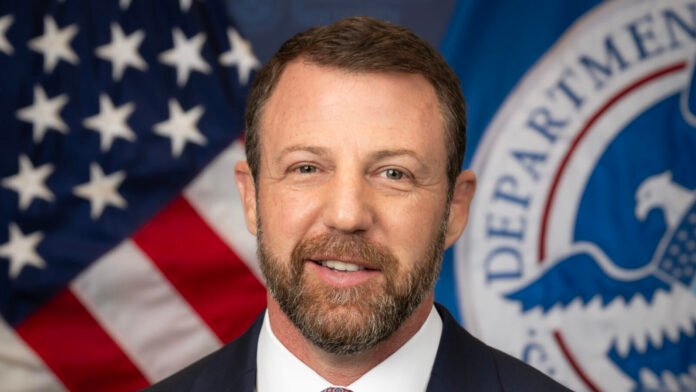
File photo: US Homeland Security Secretary Markwayne Mullin, official portrait, March 20, 2026. Photograph: Tia Dufour / US Department of Homeland Security, public domain (US federal government), via Wikimedia Commons. Cropped and resized. Image source and public-domain status.
Sources
- US Federal Register: Notice of Order Regarding Exclusion and Removal of DeepSeek Products
- Associated Press: China defends DeepSeek after US ban of its AI from government systems
- Reuters via The News: China says US DeepSeek ban disregards Xi–Trump consensus

The Tech Desk covers technology, artificial intelligence and cybersecurity. Stories are checked against at least two credible sources before publication.