October 26: South Korea’s two major memory-chip companies are due to report third-quarter results this week, providing a new set of company disclosures for readers following the AI investment cycle. SK Hynix has scheduled its announcement for October 28, while Samsung Electronics will hold its results call on October 29. Both dates and times come from the companies themselves.
Key highlights
- SK Hynix plans its earnings release before 9am Seoul time on October 28.
- Samsung’s conference call is scheduled for 10am Seoul time on October 29.
- Samsung has already published preliminary sales and operating-profit guidance.
- Full results and management commentary remain separate from forecasts about AI demand.
The confirmed reporting calendar
SK Hynix’s October 21 invitation says its press release will precede a 9am conference call on October 28, with Korean-English interpretation. Samsung’s formal disclosure schedules its call for 10am on October 29 and says presentation materials and the webcast will be available through investor relations.
Our calculation: Seoul is UTC+9 and India is UTC+5:30, so the scheduled calls correspond to 5:30am IST for SK Hynix and 6:30am IST for Samsung. These are call times, not a promise about when every document will be posted.
| Company | Scheduled call, Seoul | Corresponding India time |
|---|---|---|
| SK Hynix | October 28, 9:00am | October 28, 5:30am IST |
| Samsung Electronics | October 29, 10:00am | October 29, 6:30am IST |
What Samsung has already disclosed
Samsung’s October 8 preliminary guidance estimates consolidated sales of about 195 trillion won and operating profit of about 107.40 trillion won. The company identifies these as estimates under Korean International Financial Reporting Standards; they should not be relabelled audited final results.
The same release gives second-quarter sales of 171.5 trillion won and operating profit of 89.49 trillion won as comparison figures. Our calculation: the preliminary third-quarter sales figure is about 13.7% above that second-quarter figure: (195 − 171.5) ÷ 171.5 × 100. This is a comparison of company-reported figures, not a forecast for the share price.
How to assess the results without confusing the measures
Begin by separating revenue, operating profit and cash generation. A higher sales total does not by itself reveal the profit earned on those sales or the cash available after investment. The full statements and accompanying explanations are more informative than a headline total alone.
Next, compare like periods and like business scopes. A quarter-on-quarter change answers a different question from a year-on-year change. A consolidated group figure also should not be treated as the performance of one product category.
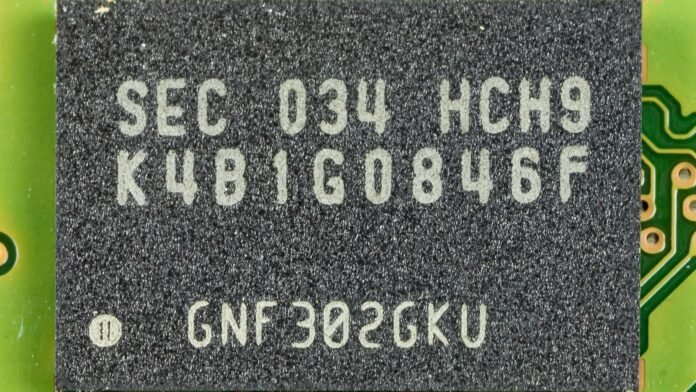
For readers tracking AI-related demand, the important evidence will be the companies’ own segment disclosures, product commentary and investment plans. Do not assume every memory product or every unit of group revenue is AI-related. The archival DDR3 photograph accompanying this report illustrates Samsung memory manufacturing; it does not show a new high-bandwidth-memory product.
What to watch on reporting days
Check whether the full numbers confirm or revise preliminary guidance, what management says about future capacity and how any investment timetable is qualified. Separate a firm commitment from a conditional plan or a response to an analyst’s question.
The confirmed news today is the reporting schedule and the guidance already on record. The upcoming results may add detail, but this article does not invent a demand figure, customer contract or earnings outcome before publication.
File photo: a Samsung DDR3 memory component; this is not a current HBM chip, March 16, 2017. Photo: © Raimond Spekking / Wikimedia Commons, CC BY-SA 4.0. Cropped and resized; not a photograph of the current event. Photo source; CC BY-SA 4.0.
Sources
- SK Hynix: Q3 2026 earnings conference-call invitation
- Samsung: Notice of Q3 2026 earnings-release schedule
- Samsung: Preliminary third-quarter earnings guidance

The Business Desk covers markets, the economy, companies and personal finance. Stories are checked against at least two credible sources before publication.