October 26: Drivers planning a November trip to Delhi should check their vehicle’s registration, fuel and emissions standard before travelling. Delhi’s June 23 notification, published in the official Gazette on July 1, sets a November 1–January 31 restriction for vehicles registered outside the capital and below BS-VI standards, with specified exemptions. This is an approaching implementation date, not a rule newly issued today.
Key highlights
- The notified winter entry restriction runs from November 1 to January 31.
- It covers outside-Delhi registration and vehicles below BS-VI, subject to exemptions.
- The notification exempts CNG, electric and specified emergency or sovereign-duty vehicles.
- Separate CAQM directions govern buses and commercial goods vehicles.
What the Delhi notification says
The operative English text is in the Delhi Gazette, Part IV, notification F. No. 10(39)/ENV/2021. It says vehicles registered outside the National Capital Territory and below BS-VI shall not ply in Delhi during the specified winter period.
The listed exemptions include CNG and electric vehicles, emergency and sovereign-duty vehicles such as ambulances, fire tenders and police vehicles, and any additional category specifically exempted by the Environment Department. An exemption for one category should not be assumed to cover a different vehicle or purpose.
| Question | What to check |
|---|---|
| Where is the vehicle registered? | The winter entry clause concerns registration outside Delhi |
| What is its emissions standard? | Check the recorded standard, not just the year or appearance |
| What fuel does it use? | Read the specified CNG and electric exemptions |
| Is it a bus or goods vehicle? | Check the applicable separate CAQM direction |
| When is the journey? | The notified entry period differs from other winter measures |
Why commercial-vehicle rules need a separate check
CAQM’s earlier directions address commercial goods vehicles and different bus-permit arrangements. The commission’s published amendment to Direction 88 sets out the transition for BS-IV goods vehicles, while its Direction 93 account deals with cleaner modes for buses entering Delhi.
A private-car owner should not treat a bus operator’s permission as an exemption for a car. Equally, a goods operator needs to examine the applicable commercial-vehicle instruction rather than relying solely on a general headline about winter restrictions.
A practical checklist before leaving home
First, identify the vehicle’s official registration and emissions details. Do not infer compliance simply because a vehicle was bought recently or because another vehicle of the same model is permitted.
Second, check whether the journey falls inside the notified period and whether an actual exemption applies. If relying on an exemption, obtain the relevant official wording rather than a social-media summary.
Third, confirm the latest transport and traffic instructions before departure. The Gazette states that more stringent GRAP measures take priority when invoked. A date-based winter provision and a pollution-stage restriction can therefore require separate checks.
Fourth, plan an alternative if the vehicle is not eligible. For a commute, compare public-transport options and the interchange needed at either end. For commercial travel, confirm the operator’s vehicle arrangements rather than assuming a ticket settles regulatory compliance.
Different measures have different dates
The same Delhi notification contains other winter provisions, including parking and office arrangements, with their own periods and exceptions. The vehicle-entry window should not automatically be copied onto every other measure.
This report explains the cited entry provisions and the distinction between regulatory categories. It does not certify an individual vehicle’s eligibility or reproduce every part of Delhi’s winter action framework.
What to watch before November 1
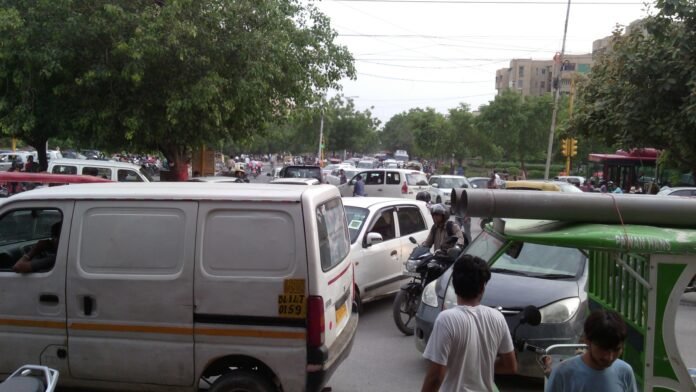
Look for further Environment Department, transport, traffic-police or CAQM instructions that amend or clarify implementation. The official notification and category-specific directions should control travel decisions. The photograph is an archival road scene from 2018, not evidence of a current checkpoint or enforcement operation.
File photo: road traffic in New Delhi, August 4, 2018. Photo: Rrthakur22 / Wikimedia Commons, CC BY-SA 4.0. Cropped and resized; not a photograph of the current event. Photo source; CC BY-SA 4.0.
Sources
- Delhi Gazette: Notification F. No. 10(39)/ENV/2021, June 23, 2026
- CAQM: Amendment to Direction 88 on commercial goods vehicles
- CAQM: Direction 93 on cleaner buses entering Delhi

The National Desk covers India's politics, governance, security and public-interest news. Stories are checked against at least two credible sources before publication.