October 26: Japan and South Korea have broadened their official AI discussions to cover research, safety, intellectual property and cooperation across the technology stack, according to South Korea’s account of an October 21 meeting in Seoul. The two sides plan regular working-level talks. The announcement describes a cooperation process, not a newly signed bilateral AI law.
Key highlights
- The second working-level meeting took place in Seoul on October 21.
- Officials discussed national policies, research and cooperation across the AI stack.
- Safety, intellectual property and multilateral coordination were on the agenda.
- Regular meetings are planned; no common regulatory regime is announced in the release.
What the latest meeting covered
The Korean Foreign Ministry’s release, published through Korea.net, says both delegations included officials from several ministries and AI-related institutions. The discussion covered their respective policies, research opportunities and governance questions. It does not publish a project budget, procurement contract or timetable for a joint product.
The range of institutions is relevant because AI policy extends beyond a single model or application. Research, standards, intellectual-property administration and safety evaluation can involve different public bodies, even when they address the same technology.
How the dialogue began
The Korean Foreign Ministry’s February 5 account places the first meeting in Tokyo. It links the working-level process to the September 2025 summit and the subsequent science-and-technology committee discussions. The first session covered national policies, multilateral governance and practical cooperation, including physical AI.
That earlier account gives the October meeting a documented institutional history. It is a second stage in an existing dialogue rather than evidence that the two governments created an entirely new partnership this week.
| Discussion area | A practical question for future announcements |
|---|---|
| Research | Is a named joint project or institution identified? |
| AI safety | What evaluation method and responsibility are specified? |
| Intellectual property | Are rights, permissions and dispute procedures explained? |
| Multilateral cooperation | Is there an agreed position or only an exchange of views? |
What governance principles contribute
The OECD’s AI Principles provide an independent reference for the governance vocabulary. They call for transparency, meaningful information about capabilities and limitations, robustness and appropriate human oversight. They also discuss accountability across the AI system’s lifecycle.
Those principles help readers understand the issues under discussion, but they are not proof that the Seoul meeting adopted a particular technical test or legal obligation. A shared topic and a jointly implemented rule are different levels of cooperation.
Why the research and copyright questions are connected
A research collaboration needs more than an agreement to meet. It needs a defined objective, participants, resources and rules for handling data and outputs. Intellectual-property questions can arise at several stages, from access to research material to the use of resulting tools.
The practical test for a later announcement is therefore specificity. A statement identifying a funded project and its participating institutions is more concrete than a general promise to explore opportunities. An evaluation protocol is more informative than a broad reference to safe AI.
For businesses and researchers, the present announcement is a signal to follow those official channels. It should not be interpreted as automatic access to government funding, permission to use any dataset or recognition of every AI product across both markets.
What to watch next
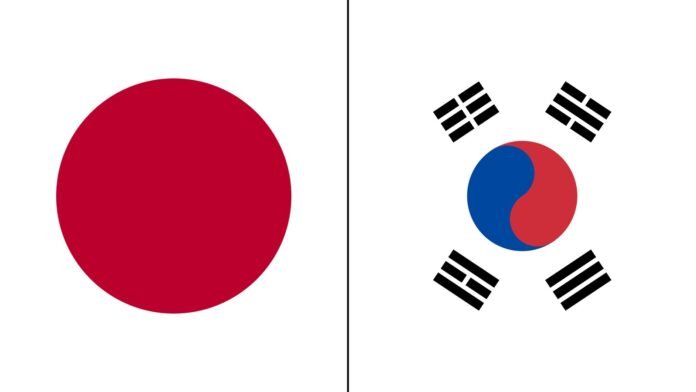
Look for named research programmes, published safety work and further working-level meeting accounts. The current release supports the agenda and intention to continue the dialogue; it does not establish a completed regulatory merger. The accompanying national-flag illustration is representational and does not depict the meeting.
File photo: an illustration of the Japanese and South Korean national flags, March 21, 2024. Photo: Alexander517 / Wikimedia Commons, CC0 1.0. Cropped and resized; not a photograph of the current event. Photo source; CC0 1.0.
Sources
- Korean Foreign Ministry / Korea.net: Second Japan–Korea AI working-level meeting
- Korean Foreign Ministry: First AI working-level meeting, February 2026
- OECD: AI Principles on transparency, safety and accountability

The Tech Desk covers technology, artificial intelligence and cybersecurity. Stories are checked against at least two credible sources before publication.