SEOUL, November 1: South Korea’s exports jumped 93.7% from a year earlier to $115.28 billion in October, the second month in a row above $110 billion, as semiconductors alone brought in $56.44 billion, the trade ministry said on Sunday. Exports for January–October reached $930 billion, leaving the country about $70 billion short of its first $1 trillion export year — a mark the ministry says is now certain to be reached in November.
Key highlights
- October exports: $115.28 billion (+93.7%); imports: $72.78 billion (+36.0%); trade surplus: $42.50 billion.
- Semiconductor exports rose 259.4% to $56.44 billion — about 49% of all exports — on continued AI-related investment by global tech companies.
- Average daily exports rose 76% to $5.24 billion, a cleaner measure because the Chuseok holiday fell in October last year but in September this year.
- Exports to the United States rose 185.8%, to China 133.6% and to ASEAN 128.0%; shipments to India rose about 84%.
- January–October exports of $930 billion (+60.6%) passed $900 billion for the first time; the cumulative surplus is $294.9 billion.
The month in numbers
| Measure | October 2026 | Change on a year earlier |
|---|---|---|
| Exports | $115.28 bn | +93.7% |
| Imports | $72.78 bn | +36.0% |
| Trade balance | +$42.50 bn surplus | +$36.50 bn |
| Average daily exports | $5.24 bn | +76% |
| Exports, January–October | $930.0 bn | +60.6% |
| Imports, January–October | $635.1 bn | +21.4% |
| Trade balance, January–October | +$294.9 bn | +$239.1 bn |
October was the second-largest export month on record, behind September’s $121.1 billion, and 18 of the 20 main export items grew.
Chips, computers and the AI build-out
The ministry said semiconductor exports stayed above $50 billion for a second month because big technology companies kept spending on AI infrastructure, keeping both prices and volumes high. It cited fixed prices for DDR5 16Gb memory chips rising from $40.0 in June to $50.0 in October, while 128Gb NAND rose from $28.8 to $30.6. Computer exports, mostly server equipment and server SSDs, rose 496.6% to $5.85 billion, and electrical equipment such as transformers and cables for AI data centres hit a monthly record of $1.99 billion (+74.0%).
| Product | Exports (US$ bn) | Change |
|---|---|---|
| Semiconductors | 56.44 | +259.4% |
| Petroleum products | 6.92 | +80.0% |
| Automobiles | 6.55 | +18.1% |
| Computers | 5.85 | +496.6% |
| General machinery | 4.1 | +24% |
| Petrochemicals | 4.00 | +27.5% |
| Ships | 2.64 | −43.6% |
| Steel | 2.29 | +22.3% |
| Electrical equipment | 1.99 | +74.0% |
| Wireless devices | 1.95 | +6.7% |
| Bio-health | 1.53 | +30.2% |
| Cosmetics | 1.44 | +57.5% |
Car exports of $6.55 billion were the highest for any October, helped by hybrid vehicles and more working days. Ship exports fell because last October included a $2.47 billion offshore-plant delivery. Oil-related exports rose in value because prices stayed high — the ministry put Dubai crude at $110.7 a barrel, up 70.4% — but export volumes of petroleum products and petrochemicals actually fell by 7.5% and 6.8%.
Where the goods went
| Destination | Exports (US$ bn) | Change |
|---|---|---|
| China | 26.98 | +133.6% |
| United States | 24.90 | +185.8% |
| ASEAN | 21.33 | +128.0% |
| European Union | 8.10 | +56.4% |
| Japan | 3.2 | +44% |
| Latin America | 3.0 | −37% |
| India | 2.7 | +84% |
| Middle East | 1.67 | +11.0% |
| CIS | 0.9 | −32% |
Exports to ASEAN reached a record $21.33 billion, led by chips, displays and petroleum products. Shipments to the Middle East rose 11.0% despite difficulties in moving ships through the Strait of Hormuz, the ministry said. On the import side, energy imports rose 63.1% to $16.49 billion: crude oil imports fell 6.3% in volume but cost 51.9% more, at $10.7 billion. Imports of chip-making equipment rose 49.2% to $2.52 billion.
What the minister said
Trade and Industry Minister Kim Jung-kwan said exports had kept up solid growth above $110 billion in October and that reaching $1 trillion in annual exports in November was now certain. He credited demand for chips and other advanced products driven by AI, and the competitiveness of Korean companies. He added that many small and mid-sized firms still face pressure from protectionism in major economies, supply-chain reshuffling and instability in the Middle East.
Our calculation
- Chip dependence: $56.44 billion of $115.28 billion means semiconductors made up about 49% of October exports. Everything else together was about $58.8 billion, up 34% according to the ministry.
- Holiday effect: the headline 93.7% growth is flattered by the Chuseok holiday moving out of October. The 76% rise in daily exports is the better guide to underlying demand.
- Price, not volume, for oil: crude import volumes fell 6.3% while the unit price rose 62.0%, so the higher import bill reflects prices.
- Road to $1 trillion: the remaining $70 billion equals about 13 working days at October’s daily average of $5.24 billion — which is why the ministry expects the mark in November.
- India’s slice: about $2.7 billion of exports went to India, roughly 2.3% of the total.
What it means
Korea is the clearest gauge of the AI hardware boom in Asia: half its exports are now chips, and server, power-equipment and data-centre demand is lifting other products too. That concentration is a strength while memory prices rise, but it leaves the economy exposed to any slowdown in AI investment. For India and Southeast Asia, Korea’s numbers point to strong demand for components and continuing high prices for memory chips used in phones and servers. The high oil price shows up on both sides of Korea’s ledger, inflating fuel exports and import bills alike.
What to watch
- The day Korea’s annual exports cross $1 trillion in November, and the trade ministry’s November 1–10 and 1–20 preliminary figures.
- Memory-chip contract prices, which drove most of this year’s gains.
- Oil prices and shipping through the Strait of Hormuz, which affect both fuel exports and energy imports.
- Exports by small and mid-sized firms, which the minister flagged as under pressure.
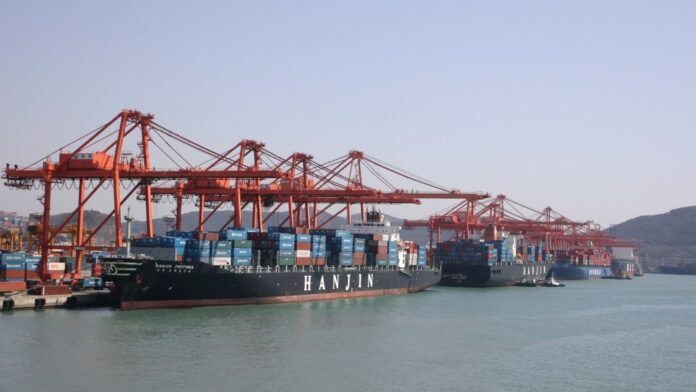
File photo: a container terminal at the port of Busan, South Korea’s largest port. Image: Niels Johannes, CC BY-SA 4.0, via Wikimedia Commons. Photo source · Licence
Sources

The Business Desk covers markets, the economy, companies and personal finance. Stories are checked against at least two credible sources before publication.