SEOUL, November 1: North Korea says it has tested a cluster-bomb warhead for its tactical ballistic missiles and plans to give units a choice of several cluster-warhead types before the end of the year, according to its state media. South Korea’s military said it had tracked a launch towards the Yellow Sea from near Chongju on Saturday, October 31, in close coordination with the United States. The test came a day after the US, Japanese and South Korean foreign ministers renewed their call for North Korea’s complete denuclearisation.
Key highlights
- North Korea’s Missile Administration tested a cluster-bomb warhead for tactical ballistic missiles on October 31, state media said.
- State media claimed a “Standard Type 2” cluster warhead can destroy a target area of 12–13 hectares at its highest density.
- An official said cluster warheads come in four types by purpose and that units would be able to choose and use all of them “within this year”.
- South Korea’s Joint Chiefs of Staff said it tracked the launch from the Chongju area towards the Yellow Sea and maintained a readiness posture.
- It was the second North Korean launch in three days: Japan’s Defence Ministry reported a suspected ballistic missile launch on October 29.
What North Korea claimed
According to North Korean state media, the Missile Administration carried out the test to assess the combat suitability and power of a cluster-bomb warhead for tactical ballistic missiles, and research institutes confirmed the area-coverage claim. In April, North Korea said it had tested cluster munitions on a Hwasong-11 series tactical ballistic missile. Its claims about destructive power could not be independently verified.
A cluster warhead releases many smaller submunitions over a wide area instead of a single explosive charge. That makes it more effective against spread-out targets such as airfields, troop positions or artillery sites, and more dangerous to civilians, because unexploded submunitions can remain on the ground long after an attack.
How Seoul and its allies responded
South Korea’s Joint Chiefs of Staff said it had monitored the launch from the Chongju area of North Pyongan province towards the Yellow Sea, shared information closely with the United States and maintained readiness. Meeting on the sidelines of the G20 foreign ministers’ meeting in Atlanta on October 30, US Secretary of State Marco Rubio, Japanese Foreign Minister Toshimitsu Motegi and South Korean Foreign Minister Cho Hyun reaffirmed their commitment to North Korea’s complete denuclearisation and called for full implementation of UN Security Council resolutions, including the ban on supporting revenue for its weapons programmes.
Rubio told reporters on October 31 that President Donald Trump was open to talks with Kim Jong Un if Pyongyang was prepared to address US and allied concerns, but that nothing had been scheduled. On the same day, the FBI separately blamed North Korean hackers for a record $6.3 billion crypto theft.
| Date | Event | Source |
|---|---|---|
| October 29 | Suspected ballistic missile launch; no entry into Japan’s EEZ confirmed | Japan Defence Ministry |
| October 30 | US–Japan–South Korea foreign ministers call for complete denuclearisation | US State Department |
| October 31 | Launch towards the Yellow Sea tracked from the Chongju area | South Korea’s Joint Chiefs of Staff |
| October 31 | FBI attributes the Binance theft to North Korea’s TraderTraitor group | FBI |
| November 1 | State media reports the cluster-warhead test and year-end deployment plan | North Korean state media |
Our calculation
- Area claimed: 12–13 hectares is 0.12–0.13 square kilometres — roughly 17 to 18 standard football pitches of 105 by 68 metres.
- Timeline: if the year-end goal holds, North Korea is giving itself about two months to field all four cluster-warhead types.
What it means
Short-range tactical missiles with cluster warheads are aimed at the battlefield in and around the Korean Peninsula rather than at distant targets, which makes them a direct concern for South Korea and US forces stationed there. The plan to field several types quickly suggests North Korea wants a range of options below the nuclear threshold. For Japan, China and the wider region, the tests add to tension at a time when talks with Washington remain an offer rather than a plan.
What to watch
- Further launches as North Korea moves towards its year-end deployment goal.
- Any UN Security Council discussion or new sanctions designations.
- Whether the US offer of talks leads to any contact with Pyongyang.
- South Korea–US military exercises and readiness measures in the coming weeks.
Related: Japan reports a suspected North Korean ballistic launch on October 29.
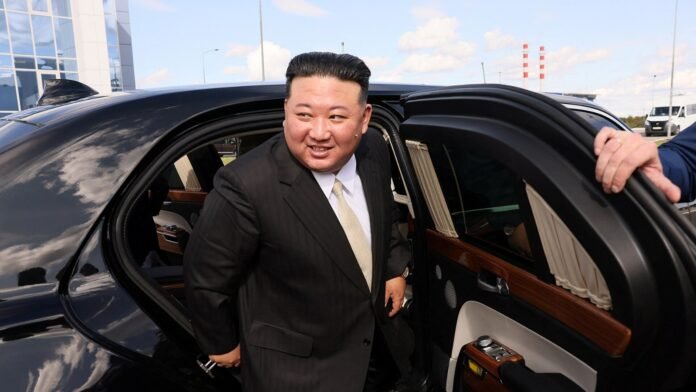
File photo: North Korean leader Kim Jong Un in September 2023; not a photograph of the October 31 test. Image: Office of the President of Russia (kremlin.ru), CC BY 4.0, via Wikimedia Commons. Photo source · Licence
Sources
- US Department of State: US–Japan–ROK trilateral foreign ministers’ meeting, October 30, 2026
- US Department of State: Secretary of State Marco Rubio at a press availability, October 31, 2026
- United Nations Security Council: Committee established pursuant to resolution 1718 (2006)

The International Desk covers world and Asian affairs, diplomacy and conflict, with a focus on what they mean for India. Stories are checked against at least two credible sources before publication.