November 2: India’s Bharat Renewable Energy Summit & Expo 2026 is scheduled to begin on November 2 at Bharat Mandapam in New Delhi, with Prime Minister Narendra Modi due to inaugurate it at around 4:30pm, according to the Prime Minister’s Office. The four-day programme runs until November 5 and brings investment discussions, an exhibition, the International Solar Alliance Assembly and a green-hydrogen conference into the same week. This report is a preview of the announced programme, not an account of an inauguration that has already taken place.
Key highlights
- The summit is scheduled for November 2–5 at Bharat Mandapam, New Delhi.
- The PMO has announced an inauguration at around 4:30pm on November 2.
- Organisers expect participation from over 130 countries and more than 40 ministers.
- Investment commitments, signed agreements and completed projects must be distinguished.
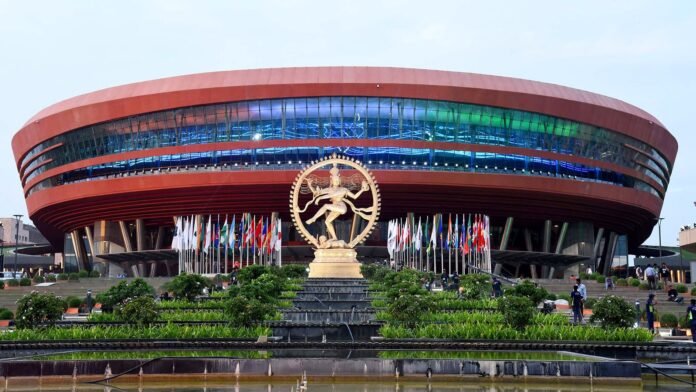
File photo: Bharat Mandapam in New Delhi (September 6, 2023). Credit: Ministry of Culture, Government of India / Wikimedia Commons, GODL-India. Cropped and resized by The Press of Asia. The venue photographed before the 2023 G20 summit; this does not show the November 2026 energy summit.
Three platforms, with different jobs
The PMO says the summit will take place alongside the ninth session of the International Solar Alliance Assembly and the fourth International Conference on Green Hydrogen. The summit’s main emphasis is clean-energy investment, industry engagement and technology partnerships. The ISA Assembly concerns international solar cooperation, finance and institutional capacity, while the hydrogen conference addresses technologies, investment and scale-up.
Holding them together can connect discussions that are often treated separately: generating clean electricity, financing it and finding industrial uses for lower-carbon fuels. It does not merge their formal decision-making roles. A decision of the ISA Assembly, a company announcement at the expo and a ministerial speech are different kinds of outcome.
At a glance
| Item | Confirmed detail | Why it matters |
|---|---|---|
| Dates and venue | November 2–5; Bharat Mandapam, New Delhi | Four-day programme |
| Inauguration plan | Around 16:30 IST on November 2 | Announced schedule, not a completed-event claim |
| Parallel events | 9th ISA Assembly; 4th green-hydrogen conference | Related platforms with different roles |
| Announced scale | 130+ countries; 40+ ministers; 400+ exhibitors | Expectations, not verified attendance |
| Ministry capacity context | 308 GW non-fossil capacity; 500 GW target for 2030 | Do not relabel non-fossil capacity as renewable-only capacity |
What has been announced for participants
The official programme identifies Australia, Denmark, the European Union, France, Germany, the Netherlands, Norway, Sweden and the United Kingdom as nine country partners. The organisers also expect more than 400 exhibitors. These figures describe the announced participation and exhibition scale; they should not yet be reported as verified attendance totals.
Thirteen states and Union Territories are due to showcase renewable-energy opportunities and manufacturing capabilities. They include Andhra Pradesh, Assam, Bihar, Chhattisgarh, Delhi, Gujarat, Karnataka, Madhya Pradesh, Maharashtra, Odisha, Rajasthan, Uttar Pradesh and West Bengal. Their presence gives investors a way to examine state-level opportunities rather than rely only on national targets.
The programme includes plenary discussions, ministerial sessions, CEO roundtables, country and state sessions, and meetings between businesses and governments. The Ministry of New and Renewable Energy’s earlier briefing also described a hackathon, a national renewable-energy quiz and a REGen Pavilion for younger innovators and researchers.
The investment question behind the event
In its October 28 briefing, MNRE quoted Secretary Santosh Sarangi as saying India had 308 GW of installed non-fossil capacity and would need approximately US$220 billion of investment between 2027 and 2030 to support its ambitions. Non-fossil capacity is not identical to renewable capacity, and the ministry’s investment estimate is a requirement, not money already secured.
Our calculation: 308 GW is 192 GW below the stated 500 GW target for 2030. This simple subtraction shows the scale of the remaining capacity gap at the time of the ministry’s briefing. It is not an annual construction forecast and does not account for future additions, retirements or revisions.
Capacity is also only one part of the transition. Storage, transmission, grid integration and dependable access to finance determine how much of the available generation can be used when it is needed. A project can be attractive on paper and still face delays if its connection, buyer or financing structure is not ready.
How to assess the announcements
Readers should separate expressions of interest, memoranda of understanding, financing agreements and operating projects. An investor’s intention can be newsworthy, but it should not be counted as a commissioned power plant. The same discipline applies to a proposed manufacturing facility or hydrogen project.
For a company announcement, useful details include the location, proposed capacity, technology, buyer, financing status and expected completion date. For a public-policy announcement, the key questions are whether it is a proposal or an operative rule, when it starts and who is eligible. Those details determine whether the event changes a business decision.
For households and small businesses, the wider significance may lie in cheaper or more reliable clean-energy products and better access to suppliers. The event itself does not establish a new consumer subsidy or a guaranteed reduction in electricity bills. Any such claim needs its own official scheme or tariff announcement.
What to watch
The first confirmed developments to watch are the inauguration, the final programme and the text of any formal decisions or agreements. Subsequent reporting should identify what was actually signed or adopted, rather than convert advance participation estimates into achievements.
The summit’s announced scale makes it a significant clean-energy gathering for India and international partners. Its lasting value will be measured by delivered projects, workable financing and implemented cooperation after the exhibition closes, not simply by the number of names on an opening-day agenda.
Sources
- Prime Minister’s Office via PIB: PM to inaugurate Bharat Renewable Energy Summit on November 2
- Ministry of New and Renewable Energy via PIB: Summit programme and investment priorities

The Business Desk covers markets, the economy, companies and personal finance. Stories are checked against at least two credible sources before publication.