
Beijing, September 28: Profits at China’s major industrial companies rose 15.7% in the first eight months of 2026, official data released on Sunday showed. But growth slowed sharply to 4.2% in August, as an AI-driven boom in electronics continued to mask weak demand across much of the rest of the economy.
Key highlights
- Year to date: Profits of industrial firms above designated size reached 5.27 trillion yuan in January-August, up 15.7% year on year, according to the National Bureau of Statistics (NBS).
- August slowdown: Profits rose 4.2% in August alone, down from 11.2% in July, Reuters reported. Year-to-date growth has eased from 17.6% at the end of July.
- Electronics dominate: Profits in the computer, communication and electronic equipment sector jumped 110% and contributed 62% of total profit growth.
- Laggards: Power, heat, gas and water utilities saw profits fall 12%, and beverages, wine and refined tea fell 34.7%.
- Prices: China’s producer price index rose 3.8% year on year in August.
Two readings of the same data
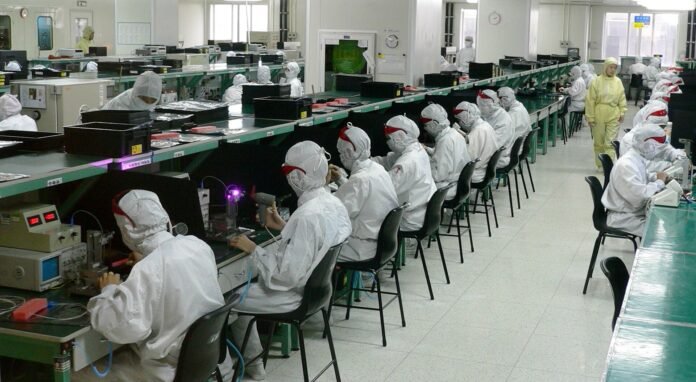
Beijing’s official framing focused on the strength of new industries. “The accelerated expansion of new technology applications, represented by artificial intelligence, has driven the expansion of demand in related fields, propelling swift profit growth in the electronics industry,” NBS statistician Yu Weining said, as quoted by Xinhua. High-tech manufacturing profits rose 54.7% in January-August, 39 percentage points faster than the overall rate. Profits in optoelectronic device manufacturing climbed 72%, and in semiconductor discrete devices 51.8%.
Reuters put the emphasis on the slowdown and the imbalance underneath it. Its report noted that domestic demand remains weak, with many firms struggling to raise prices in the face of soft consumption and excess capacity. It also cited a central bank adviser’s warning that AI “may worsen and extend China’s imbalance between robust supply and subdued demand”, adding to calls for stronger support for household spending.
Why August slowed
Part of the slowdown reflects a tough comparison. Profits had jumped 20.4% in August 2025, then the fastest rate since December 2023, which makes this August’s increase look smaller. But the sector figures point to real pressure beyond base effects:
- Energy costs: Utility profits fell 12% to 536.3 billion yuan in January-August. Oil prices have surged this year, and Brent crude traded above $107 a barrel on Monday as US-Iran talks stalled.
- Consumer weakness: The 34.7% fall in beverage, wine and tea profits points to cautious household spending, echoing a slowdown in premium liquor sales that has been widely discussed on Chinese social media this month.
- Narrow gains: With a single sector providing more than three-fifths of profit growth, much of the economy is growing far more slowly than the headline figure suggests.
Elsewhere in industry, mining profits rose 35.1% to 766.15 billion yuan, manufacturing profits rose 17.4% to 3.97 trillion yuan, and raw materials manufacturing profits jumped 47.3%, according to Xinhua. Industrial output grew 5.3% in the first eight months, and the profit margin on operating revenue rose to 5.66%.
What it means for Asia and India
China’s AI hardware boom is part of a wider regional story. Chip-driven exports have lifted South Korea (see our report) and Taiwan, and Chinese firms such as Alibaba are pushing into AI chips of their own (details here). China’s exports also surged 25% in August (our coverage).
The combination of booming factory output and weak demand at home matters for neighbours such as India. When Chinese producers cannot sell enough domestically, more of their goods tend to be pushed into export markets, which can mean sharper price competition for Indian manufacturers, particularly in electronics, steel and chemicals. At the same time, cheaper Chinese components can help Indian assemblers. How Beijing responds, whether by stimulating consumption at home or by leaning further on exports, will shape that balance.
What to watch
- Golden Week spending: The National Day holiday from October 1 to 7 will be an early test of household demand. The People’s Bank of China has said it will offer banks up to 1 trillion yuan a day in liquidity over the holidays, Bloomberg reported.
- Policy signals: Whether Beijing adds measures aimed at consumers rather than producers.
- September data: The next profits release, due in late October, will show whether August was a blip or the start of a broader slowdown.
The data also comes days after the Trump-Xi summit ended with a farm deal and a trade truce extended into 2027 (read more), which removes one near-term risk for Chinese exporters.
Sources
- Xinhua: Profits of China’s major industrial firms up 15.7 pct in first eight months
- Xinhua: China’s industrial profits retain double-digit growth via high-tech, new growth drivers
- Reuters (via 93.3 The Drive): China’s industrial profit growth slows further as economic imbalances deepen
- Xinhua: Profits of China’s major industrial firms up 17.6 pct in first seven months
- Tiger Brokers: analysis of August 2025 industrial profits data (base effect)
- China Trading Desk: China’s social media highlights, 21-25 September 2026
- The National: Oil prices rise as US-Iran peace talks hit stalemate
- Bloomberg: PBOC to offer banks up to 1 trillion yuan a day over holidays

The Business Desk covers markets, the economy, companies and personal finance. Stories are checked against at least two credible sources before publication.