October 31: WHO, the Coalition for Epidemic Preparedness Innovations and PATH are working on a draft system to measure Nipah disease severity consistently in future vaccine studies. WHO’s October 30 update describes progress following an expert consultation held in Kathmandu from August 11 to 13. The announcement concerns research preparedness: it does not report a new Nipah outbreak or announce an approved vaccine.
Key highlights
- Experts developed an initial draft disease severity score after the Kathmandu consultation.
- Further refinement and validation are still required.
- The main purpose is consistent assessment in future vaccine-efficacy trials.
- The update must not be interpreted as evidence that a new “Nipah-X” outbreak has occurred.
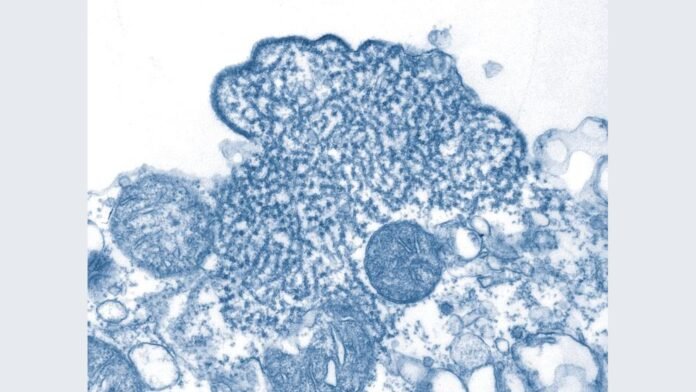
File photo: Nipah virus particles in a transmission electron micrograph. Credit: CDC / C. S. Goldsmith and P. E. Rollin / Wikimedia Commons, public domain (US federal government). Archival micrograph; not evidence of a new outbreak. Resized on a neutral background.
What the research group is developing
WHO’s South-East Asia office said the consultation brought together expertise in surveillance, outbreak response, clinical care, biostatistics and vaccine-trial design. Participants examined clinical signs and other factors that could form part of a disease severity score, as well as approaches to developing and validating it.
The work sits within CEPI’s Nipah Vaccine Outbreak Trial Planning and Preparedness project, abbreviated NiVOTriPP. According to WHO, the draft will undergo further technical working-group review. The intended result is a more consistent way to measure disease severity when assessing vaccine efficacy.
At a glance
| Question | Current position |
|---|---|
| Consultation | Kathmandu, August 11–13 |
| Public update | October 30, 2026 |
| Tool status | Initial draft; further validation planned |
| Main intended use | Consistent severity measurement in vaccine trials |
| New outbreak announced? | No |
Why a common severity score could help
A vaccine trial needs a clear definition of the outcome it is trying to prevent. If different study locations describe severe illness differently, comparing results becomes harder. A standardised score is intended to make those assessments more consistent, although its reliability must be demonstrated before researchers can rely on it for a particular use.
For example, a future study would need to distinguish its pre-specified clinical outcomes from observations collected only after the trial starts. Clear definitions help prevent an apparent difference between groups from being created by inconsistent classification. This is an explanation of the research problem, not a description of results from a completed Nipah efficacy trial.
Validation is therefore more than an administrative step. Researchers need to test whether a proposed tool measures the outcome consistently and works in the settings where it will be used. An expert-developed draft can be a starting point without yet being an established clinical instrument.
What “Nipah-X” means in this update
WHO uses the term in discussing preparedness for a potentially larger outbreak that could make a vaccine-efficacy study feasible. It is a planning scenario in the project description. The update does not identify it as a newly detected variant, name a new outbreak location or provide a new case count.
That distinction matters because the project is preparing a flexible trial protocol for circumstances that may arise. Preparation does not mean those circumstances have already occurred. It would be inaccurate to convert a research-planning phrase into a warning that a new strain is spreading.
WHO’s general Nipah fact sheet describes the infection as zoonotic and discusses transmission through infected animals, contaminated food and person-to-person contact. That background explains the public-health interest in preparedness, but it should not be confused with current surveillance findings for any particular country.
What happens next
The immediate milestone is refinement and validation of the draft score. A separate question is whether and when a future vaccine study can be conducted under an appropriate protocol. Progress on one part of research infrastructure does not establish the safety or efficacy of a vaccine candidate.
Readers should look for a published methodology, validation evidence and clearly defined study endpoints in subsequent updates. Health authorities’ outbreak notices remain the appropriate source for current case information. This article does not provide a diagnosis, advise changes to treatment or claim that the draft score is ready for routine patient use.
The Kathmandu meeting took place in August; the new development is WHO’s October 30 account of the work and its next phase. Keeping both dates visible avoids presenting a past consultation as an event taking place this week.
Sources
- WHO South-East Asia: WHO, CEPI and PATH work on a Nipah disease severity score
- WHO: Nipah virus fact sheet

The International Desk covers world and Asian affairs, diplomacy and conflict, with a focus on what they mean for India. Stories are checked against at least two credible sources before publication.