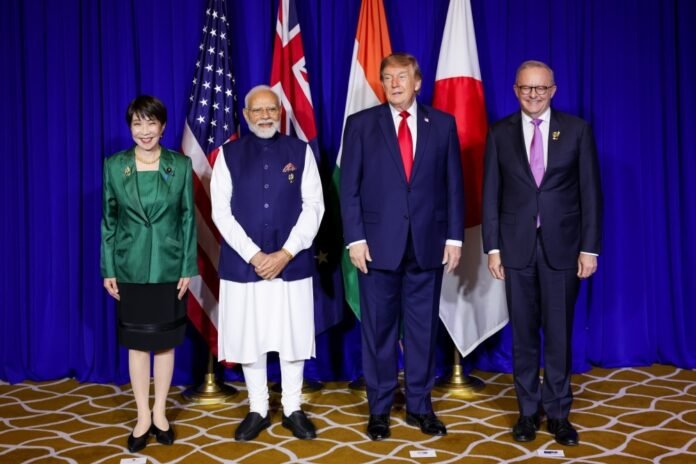
November 18: The leaders of Australia, India, Japan and the United States have announced plans for a 2027 maritime-aircraft exercise and an inaugural business leaders’ forum after meeting in Manila on November 17. Their joint statement combines security cooperation with technology, infrastructure and private-sector priorities.
Key highlights
- P-8 and P-3C aircraft are scheduled to participate in a Quad-context exercise in 2027.
- The first Quad Business Leaders’ Forum is planned for early 2027.
- The statement also covers cables, cybersecurity and trusted AI access.
What the leaders announced
The joint release identifies Donald Trump, Anthony Albanese, Narendra Modi and Sanae Takaichi as the participants. Its maritime-surveillance initiative is intended to improve information sharing and awareness. The announced aircraft activity is scheduled for next year; it has not already taken place as a result of this meeting.
For a regional reader, the difference matters. A commitment establishes an agreed direction, while an exercise requires subsequent arrangements and execution. The release does not publish an exercise location, a detailed operational plan or a new mutual-defence obligation.
The economic and technology strand
The proposed business forum is intended to bring together companies, officials and policy specialists. The statement also affirms a technology accelerator intended to coordinate support for access, deployment and technical assistance across the Indo-Pacific. The document uses the term “Super Intelligence,” with a note explaining that Australia, India and Japan refer to artificial intelligence.
Our analysis: this terminology does not itself establish that a particular new technical capability has been achieved. The practical questions concern projects, funding, access conditions and accountable delivery. A forum and an accelerator are mechanisms for cooperation, not evidence that all participating businesses have received new infrastructure or investment.
Connectivity, cybersecurity and ASEAN
The statement welcomes an expansion of Australia’s cable-connectivity contribution to include electricity cables and sets out enhanced cybersecurity cooperation. It also reaffirms support for ASEAN centrality and unity. Japan’s published version provides a second official record of the agreed text.
These strands connect the security agenda to commercial resilience. Cables carry communications or power, while cyber incidents can disrupt services across borders. However, the announcement does not quantify the reduction in regional risk or establish that any particular planned cable has entered service.
At a glance
| Commitment | Announced timing or purpose |
| Business leaders’ forum | Early 2027 |
| P-8 and P-3C activity | Exercise scheduled in 2027 |
| Maritime surveillance | Information sharing and awareness |
| Cable partnership | Expanded Australian focus on electricity cables |
| Cyber cooperation | Enhanced joint work announced |
What to watch
Watch for implementation announcements from the four governments: dates, participants, project budgets and operational milestones. Those will distinguish the Manila commitments from subsequent delivery across the Indo-Pacific.
Sources

The International Desk covers world and Asian affairs, diplomacy and conflict, with a focus on what they mean for India. Stories are checked against at least two credible sources before publication.