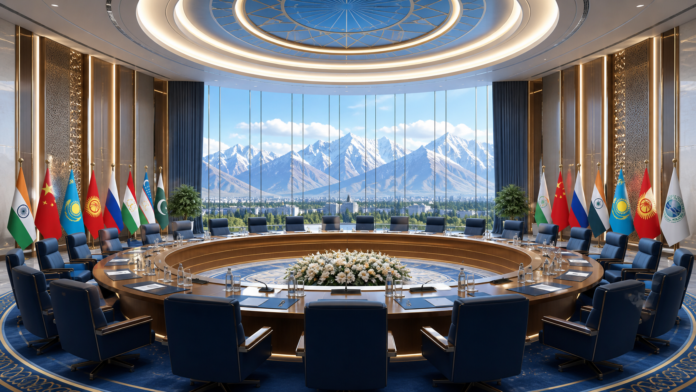
Update: Leaders of the 10 member states adopted the Bishkek Declaration on September 1, backing a “more representative and just multipolar world order”, stressing the SCO’s non-military nature, and signing more than 20 other documents on security, drug trafficking, technology, transport, energy and the environment, The Express Tribune reported. Pakistan took over the chairmanship and will host the next summit in Islamabad in 2027; no India–Pakistan bilateral meeting was reported. Asianet Newsable reported that leaders also approved a protocol amending the SCO Charter that supports adding English as an official language.
Bishkek/New Delhi, August 30: Kyrgyzstan’s capital Bishkek will host the 26th summit of the Shanghai Cooperation Organisation (SCO) on August 31 and September 1. Prime Minister Narendra Modi, Chinese President Xi Jinping, Russian President Vladimir Putin, Iranian President Masoud Pezeshkian and Pakistani Prime Minister Shehbaz Sharif are among the leaders expected.
This is more than an annual diplomatic event. Amid the Ukraine war, the US–Iran conflict, US tariff pressure on China and India, regional security and connectivity projects in Central Asia, members’ priorities overlap in some places and clash in others.
Key highlights
- The summit runs from August 31 to September 1; the formal Council of Heads of State meets on September 1.
- It also marks the SCO’s 25th anniversary.
- Modi travels to Bishkek straight after a visit to Uzbekistan.
- National coordinators worked in the last week of August to finalise the summit’s outcome documents, the SCO Secretariat said.
- The SCO works by consensus, so declarations reflect what all ten members can agree.
Why the summit matters for India
India is a full member of the SCO and sees it as a platform for security, energy, trade and connectivity links with Central Asia. The Bishkek trip follows the Prime Minister’s visit to Uzbekistan; our report on Modi’s Central Asia visit gives the full regional context. Terrorism, radicalisation, cross-border crime and Afghanistan’s stability have long been central for New Delhi, which also wants connectivity projects to respect sovereignty and territorial integrity, language linked to India’s objections to the China–Pakistan Economic Corridor.
Trade is the second challenge. Despite the SCO’s large markets, India’s trade with several members is unbalanced and physical connectivity is limited. Obstacles through Pakistan and the sanctions climate around Iran make reliable transport routes to Central Asia hard to build.
Who is in the room
| Leader | Country | What to watch |
|---|---|---|
| Narendra Modi | India | Terrorism, connectivity that respects sovereignty, access to Central Asia |
| Xi Jinping | China | A multipolar order and a possible meeting with Putin |
| Vladimir Putin | Russia | Ukraine war, energy trade and sanctions pressure |
| Masoud Pezeshkian | Iran | First summit about six months into the US–Iran war |
| Shehbaz Sharif | Pakistan | Any interaction with India would need official confirmation |
Our calculation: the SCO now has ten full members — China, Russia, India, Pakistan, Iran, Belarus and four Central Asian states — compared with six when it was founded 25 years ago. More members widen its reach but make consensus harder.
Xi and Putin have presented the SCO as a platform for a multipolar order with less Western influence, and a possible meeting between them could signal positions on Ukraine, energy trade, technology and sanctions. Pezeshkian’s attendance carries special weight: Russia and Iran have deepened military and economic ties, while Washington has warned Tehran’s trading partners of further sanctions. The presence of the Indian and Pakistani prime ministers at the same meeting will be noticed, but a formal bilateral meeting should be counted only if officially announced.
Security and Asia’s changing picture
Central Asia has long worried about terrorism, extremism, drug trafficking and risks from Afghanistan. The SCO’s Regional Anti-Terrorist Structure is a main mechanism for cooperation on these issues, and cyber security and protection of critical infrastructure may also come up. In East Asia, the US, South Korea and Japan will hold the Freedom Edge exercise in September; see our Freedom Edge 2026 report. The SCO is not a direct answer to that drill, but together they show parallel security groupings growing stronger in Asia. The SCO’s founding documents do not describe it as an alliance against anyone, so calling it a NATO-like military bloc would be misleading.
Trade, tariffs and energy
US tariffs and sanctions have sharpened the economic agenda this year. China and India both face US trade pressure, while Russia and Iran are looking for alternative payment, transport and energy markets under wide sanctions. Central Asian states see both opportunity and risk: they want to balance Chinese capital, Russian markets, Indian demand and Western investment, and push rail, road, digital and energy projects without becoming over-dependent. Any big investment announced at the summit should be treated as firm only when funding, timelines and the implementing body are clear.
The Nepal disaster as humanitarian context
Just before the summit, a devastating flood on the Nepal–Tibet border, which had killed more than 750 people with thousands missing, put regional disaster preparedness in focus; see our Nepal flood update. A political message on Himalayan risk, early-warning data and cross-border disaster cooperation is possible, but it will count as an outcome only if it appears in the final declaration or an official statement.
What to watch
- The official list of Modi’s bilateral meetings and the statements after them.
- The language on Ukraine, Iran and sanctions in Xi–Putin and Putin–Pezeshkian talks.
- How far the final declaration agrees on terrorism, trade and connectivity.
What it means
For Indian readers, the key question is whether the meeting improves access to Central Asia, energy security and cooperation against terrorism. The Press of Asia will report confirmed decisions once the summit begins.
This article was first published in Hindi and has been translated. The Press of Asia now publishes in English only.
Sources
- PIB: Prime Minister’s visit to Uzbekistan and the Kyrgyz Republic
- SCO Secretariat: Bishkek summit schedule and preparations
- SCO Secretariat: National coordinators’ meeting on outcome documents
- CNA: report on leaders attending the SCO summit in Kyrgyzstan
- The Express Tribune: Leaders back a ‘just multipolar world order’
- Asianet Newsable: PM Modi at SCO Summit: 13 outcomes, English as official language

The International Desk covers world and Asian affairs, diplomacy and conflict, with a focus on what they mean for India. Stories are checked against at least two credible sources before publication.