
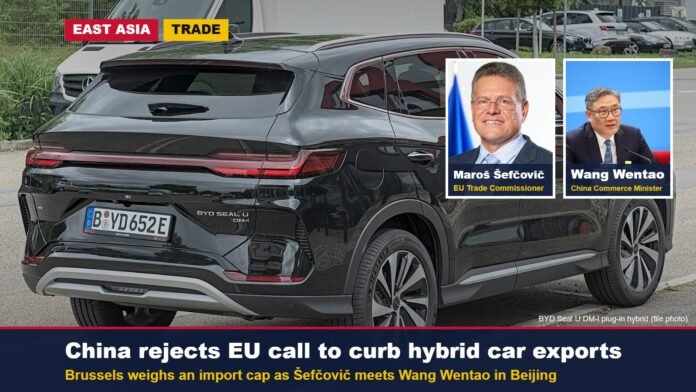
October 8: China has turned down a European Union request to voluntarily limit its exports of hybrid cars to Europe, the Financial Times reported on Wednesday, as the two sides entered what Reuters, summarising the FT report, called the last stretch of negotiations to avoid a trade conflict. On the same day Bloomberg reported that the European Commission is preparing time-limited safeguard measures that could cap imports of Chinese-made hybrids. EU Trade Commissioner Maroš Šefčovič is due in Beijing this week for talks with Commerce Minister Wang Wentao, according to Bloomberg and the electric-vehicle news site CnEVPost.
Key highlights
- According to the FT, as reported by Reuters, the Commission now hopes Beijing will accept a unilateral EU measure capping hybrid imports instead. The FT cited two diplomats briefed on the plan. Reuters said it could not immediately verify the report.
- Bloomberg, citing people familiar with the matter, said one option is a tariff-rate quota: a levy on imports above a set volume. The level, duration and start date have not been disclosed, and the plans could change.
- EU imports of Chinese hybrids rose from about 3,800 vehicles in October 2024 to about 50,000 in July 2026, according to FT figures cited by CnEVPost. That is roughly 13 times as many in 21 months, by our calculation.
- The EU’s 2024 anti-subsidy duties apply to battery-electric cars from China. Hybrids face no equivalent extra duty, CnEVPost noted.
- China’s commerce ministry said on September 18 that so-called voluntary export limits “seriously violate WTO rules”, Reuters reported.
What the EU is considering
Bloomberg reported that the Commission, which handles trade policy for the 27 member states, is preparing safeguard measures aimed at China-made hybrids after a surge in sales. Safeguards allow the EU to restrict imports in a sector after a sudden rise. According to CnEVPost’s account of the Bloomberg report, the measures would be time-limited, and hybrids are being treated as a test case: if the approach works, it could be extended to other sectors where the EU runs a large trade gap with China.
Bloomberg said Chinese-made hybrids now make up about a quarter of hybrid sales in Europe, and that imports of Chinese battery-electric cars have slowed since the EU’s duties took effect. Shares of European carmakers rose on the report, with Volkswagen up as much as 4.6%, Bloomberg said.
CnEVPost reported that EU leaders are due to discuss trade relations with China in mid-October and that the Commission plans to present measures by the end of the year. The Šefčovič–Wang meeting could shape what Brussels finally proposes.
Why hybrids are the gap
The EU’s countervailing duties on Chinese electric cars, in force since October 30, 2024 for five years, cover battery-electric vehicles, including those with a small petrol range extender, the European Commission’s trade portal says. Plug-in and conventional hybrids were not part of that investigation. The duties come on top of the EU’s standard 10% car tariff, so the highest combined rate is 45.3%, CnEVPost noted.
| Company | Extra EU duty on battery-electric cars |
|---|---|
| Tesla (Shanghai) | 7.8% |
| BYD Group | 17.0% |
| Geely Group | 18.8% |
| Other cooperating companies | 20.7% |
| SAIC Group | 35.3% |
| Non-cooperating companies | 35.3% |
What China has said
After the FT first reported in mid-September that the EU wanted Beijing to limit hybrid exports voluntarily, China’s commerce ministry said such limits “seriously violate WTO rules”, Reuters reported on September 18. The ministry said any solution must balance the interests of both sides. Foreign ministry spokesperson Guo Jiakun said: “We hope the EU will honour its commitments to market openness and free trade.”
On Thursday, a social-media account affiliated with state broadcaster CCTV, Yuyuan Tantian, said Beijing had tools to respond if the EU acts, the Hong Kong outlet Dim Sum Daily reported. The commentary listed coordination under the WTO framework and anti-discrimination, supply-chain security and foreign-subsidy investigations, and said China would defend its industries’ interests “resolutely”. No official Chinese response to the October 7 reports had been published in the sources we read.
The numbers behind the dispute
| Measure | Figure | Source |
|---|---|---|
| EU imports of Chinese hybrids, October 2024 | About 3,800 vehicles | FT figures, via CnEVPost |
| EU imports of Chinese hybrids, July 2026 | About 50,000 vehicles | FT figures, via CnEVPost |
| Increase over 21 months | About 13 times | Our calculation from the two figures above |
| Chinese share of hybrid sales in Europe | About a quarter | Bloomberg |
| Chinese share of plug-in hybrid sales in Europe | About one in three | Bloomberg, via CnEVPost and Dim Sum Daily |
| Chinese brands’ share of Europe’s new-car market, August 2026 | Nearly 12% (a record) | Bloomberg, via CnEVPost |
| EU trade deficit with China | More than €1 billion a day | Bloomberg, via CnEVPost |
| The same deficit over a year | More than €365 billion | Our calculation (€1 billion × 365 days) |
How we got here
| Date | Event | Source |
|---|---|---|
| October 30, 2024 | EU duties on Chinese battery-electric cars take effect, for five years; hybrids are not covered | European Commission |
| July 2026 | Monthly imports of Chinese hybrids reach about 50,000 | FT, via CnEVPost |
| August 2026 | Chinese brands take a record share of nearly 12% of Europe’s new-car market | Bloomberg |
| September 17, 2026 | FT reports the EU wants China to limit hybrid exports voluntarily or face higher tariffs | CnEVPost |
| September 18, 2026 | China’s commerce ministry says voluntary export limits violate WTO rules | Reuters |
| October 7, 2026 | FT: China rejects the request. Bloomberg: the Commission prepares time-limited safeguard measures | Reuters, Bloomberg |
| October 8, 2026 | CCTV-affiliated commentary lists the tools Beijing could use in response | Dim Sum Daily |
| This week | Šefčovič meets Wang Wentao in Beijing | Bloomberg, CnEVPost |
| Mid-October | EU leaders discuss trade relations with China | CnEVPost |
| By the end of 2026 | Commission expected to present measures | CnEVPost |
What it means for Asia
For Chinese carmakers, hybrids have been the part of the European market that the 2024 duties did not reach, and the figures above show how quickly that channel grew. A cap would hit it directly. Bloomberg’s report that Brussels sees hybrids as a test case also matters for China’s other exporters, because the same approach could later be applied to other sectors where the EU’s deficit is large.
One question the reports do not answer is how a cap would be limited to Chinese cars. Under the WTO Agreement on Safeguards, a safeguard measure “shall be applied to a product being imported irrespective of its source” (Article 2.2). If the EU used a standard safeguard, hybrids exported to Europe by Japanese and South Korean brands from factories outside the EU could also fall under it. How the Commission designs the measure, and whether it chooses another legal route, will decide who is affected.
What to watch
- The outcome of the Šefčovič–Wang talks in Beijing this week, and whether China offers any concession on hybrids.
- The legal form of any EU measure: a tariff-rate quota, a broader safeguard, or something else, and whether it covers non-Chinese brands.
- Whether Beijing opens any of the investigations listed in the CCTV-affiliated commentary.
- The discussion among EU leaders in mid-October and the Commission’s proposals by year-end.
Sources
- Reuters, via MarketScreener: China rejects EU request for voluntary hybrid car export curbs, FT reports
- Bloomberg, via Bloomberg Law: EU Plans Import Cap on Chinese Hybrid Cars to Protect Sector
- CnEVPost: EU plans Chinese hybrid import curbs as test case for trade rebalancing, report says
- Dim Sum Daily: Beijing says it has tools to counter EU plan to cap Chinese hybrid car imports
- Reuters, via Global Banking & Finance Review: China opposes EU voluntary limit on Chinese hybrid car exports (September 18)
- European Commission, Access2Markets: EU Commission imposes countervailing duties on imports of battery electric vehicles from China
- World Trade Organization: Agreement on Safeguards

The Business Desk covers markets, the economy, companies and personal finance. Stories are checked against at least two credible sources before publication.