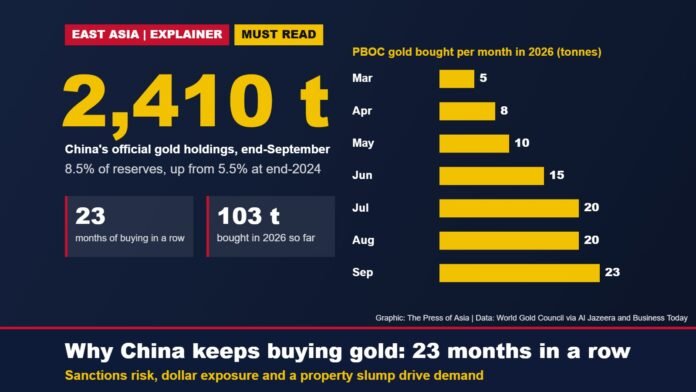
Beijing, October 17: China’s central bank bought gold for a 23rd consecutive month in September, adding about 23 tonnes, its largest monthly purchase in nearly three years, according to World Gold Council data cited by Al Jazeera and Business Today. That took the People’s Bank of China’s (PBOC) reported holdings to about 2,410 tonnes, and gold’s share of China’s official reserves to 8.5% at the end of September, up from 5.5% at the end of 2024.
The buying has continued even as gold prices fell about 8.5% over the past month, a decline the World Gold Council linked partly to a stronger dollar and higher US Treasury yields, Al Jazeera reported.
Key highlights
- September purchase: about 23 tonnes, the biggest monthly addition since September 2023 (World Gold Council data).
- Holdings: about 2,410 tonnes, still less than a third of the United States’ roughly 8,133 tonnes.
- Share of reserves: 8.5% at end-September, up from 5.5% at end-2024.
- Households are buying too: purchases of gold bars and coins in China rose 28.4% in the first half of 2026, the China Gold Association said.
- Analysts see a slow diversification away from dollar assets, not a sudden break with the dollar.
The numbers: buying has sped up in 2026
Monthly figures compiled from World Gold Council data and reported by Business Today show the pace of buying rising steadily through the year.
| Month (2026) | PBOC gold added (tonnes) |
|---|---|
| March | 5 |
| April | 8 |
| May | 10 |
| June | 15 |
| July | 20 |
| August | 20 |
| September | 23 |
Estimates differ slightly with the conversion used: Kitco, working from the official data, put the September addition at about 21 tonnes. All sources agree that September was the 23rd straight month of buying and the largest monthly addition in about three years.
Our calculation: the seven months in the table add up to 101 tonnes, close to the 103 tonnes Business Today reports for the year so far. September’s 23 tonnes is more than four times March’s 5 tonnes. And at about 2,410 tonnes, China holds roughly 30% of the US stockpile (2,410 ÷ 8,133 ≈ 0.30). The jump in gold’s share of reserves from 5.5% to 8.5% in 21 months comes from both buying and gold’s price gains over that period.
Why China is buying
Less reliance on dollar assets. Thu Lan Nguyen of Commerzbank told Al Jazeera the purchases are “part of a broader effort” to make China’s reserves more resilient by reducing dependence on US dollar assets and US Treasuries.
Sanctions risk. After Russia invaded Ukraine in 2022, Western countries froze roughly $300bn of Russian central bank assets. Gold held at home is not a claim on another country, so it is far less exposed to such freezes, Al Jazeera noted.
Worries about US debt. US federal debt passed $40 trillion earlier this year, and the Congressional Budget Office projects debt held by the public will rise from 101% of GDP to 120% between 2026 and 2036, Al Jazeera noted. For a large holder of Treasuries, that makes a gradual shift into other reserve assets more attractive.
Households want a safe store of value. Weak share markets and a long property slump with falling house prices have pushed Chinese savers towards gold. The China Gold Association reported a 28.4% rise in purchases of gold bars and coins in the first half of 2026 compared with a year earlier.
Is this de-dollarisation?
Not in any dramatic sense. Nguyen said the dollar “remains by far the dominant global reserve currency” and cautioned against reading the purchases as a major shift away from it. She described the trend as slow diversification whose economic consequences for the United States are likely to stay limited unless it spreads much more widely.
Other central banks, and where India stands
China is not alone. Poland’s central bank bought 31 tonnes in the first quarter of 2026 and about 8 tonnes in July, according to the World Gold Council. India, by contrast, has slowed sharply: the Reserve Bank of India’s holdings stood at about 880.5 tonnes as of June, after it bought only about 4 tonnes in 2025, down from 73 tonnes in 2024, Al Jazeera reported.
For Indian households, among the world’s biggest buyers of gold jewellery and coins, steady official buying by China is one of the factors that supports gold prices.
What to watch
- The PBOC’s October reserve data in early November: a 24th month of buying would extend the streak.
- Whether buying slows if gold prices keep falling, or speeds up to take advantage of lower prices.
- Chinese household demand for bars and coins in the second half of the year.
- Any change in China’s holdings of US Treasuries in US Treasury data.
What it means
China is steadily turning a small part of its reserves into an asset that no foreign government can freeze. The dollar is not about to lose its place, but each month of buying makes China a little less exposed to US financial pressure, and keeps a strong buyer under the gold market that Indian savers also depend on.
Sources
- Al Jazeera: Why is China buying up gold?
- Business Today: China buys 23 tonnes of gold in September, highest monthly purchase since 2023
- Kitco: China’s central bank buys 21 tonnes of gold in September, largest monthly purchase in 3 years

The Business Desk covers markets, the economy, companies and personal finance. Stories are checked against at least two credible sources before publication.