November 1: The foreign ministers of Japan, Australia and India and the US secretary of state have outlined new economic-security cooperation after meeting in Atlanta on October 31. Their joint statement includes an intention to provide more than $85 million in technical and financial assistance for access to trusted AI across the Indo-Pacific.
Key highlights
- The Atlanta talks took place on the sidelines of the G20 foreign ministers’ meeting.
- The joint statement sets out intended AI assistance and a new business forum.
- Critical minerals, undersea cables and important shipping routes are among the priorities.
- Funding intentions and future exercises should be distinguished from completed projects.
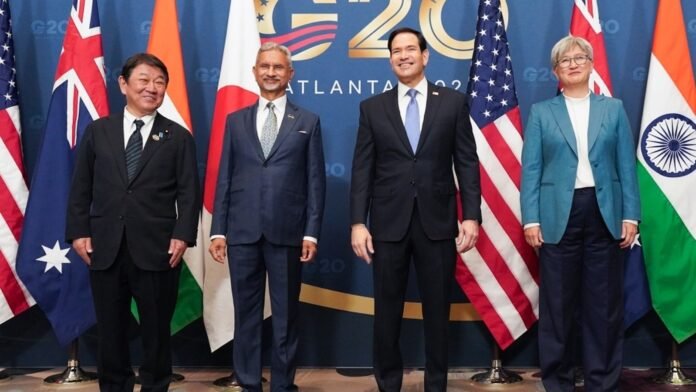
File photo: the Quad foreign ministers and US secretary of state at the Atlanta meeting (October 31, 2026). Photo: Ministry of Foreign Affairs of Japan / Japan Foreign Ministry, Public Data License 1.0. Cropped and resized by The Press of Asia. This is the ministry-released photograph of the meeting reported here. Source accessed November 1, 2026; the edited image is not a ministry-produced adaptation.
Who met, and what the announcement says
Japan’s Foreign Ministry identifies the participants as Toshimitsu Motegi, Penny Wong, S. Jaishankar and Marco Rubio. Its account says their discussion lasted about 40 minutes and was the third Quad foreign ministers’ meeting this year, following meetings in May and July.
The four-country statement describes economic security as central to stability and prosperity. It expresses concern about arbitrary export restrictions and market-distorting overcapacity, and calls for reliable supply chains and resilient infrastructure. These are the ministers’ stated positions, rather than findings from a new trade investigation.
The main commitments at a glance
| Area | What the joint statement sets out | Stage |
|---|---|---|
| Trusted AI | More than $85 million in intended technical and financial assistance, including a Quad SI Accelerator | Announced intention |
| Critical minerals | US commitment of $10 million for waste-recovery infrastructure in India and ASEAN countries | Funding commitment |
| Business cooperation | First Quad Business Leaders’ Forum | Announced initiative |
| Export credit | Agency meeting in Tokyo on November 18 | Scheduled |
| Maritime surveillance | First collaboration exercise at Sea Dragon 2027 | Planned |
The document uses the term “Super Intelligence”, with a footnote explaining that Australia, India and Japan use it to refer to artificial intelligence. The wording should not be read as confirmation that a particular company has created a new level of machine intelligence. The announcement concerns cooperation, access and infrastructure.
Why minerals, chips and shipping appear together
The joint release links critical-mineral recycling with efforts to reduce dependence on a single supplier. It describes cooperation on collection networks, processing and refineries, and an intention to explore easier cross-border movement of recyclable material while applying existing regulations.
For businesses, the practical distinction is between an agreed direction and an operating supply chain. Recycling projects still need facilities, commercially workable collection systems and compliant movement of material. An announcement alone does not establish capacity or guarantee that a manufacturer can immediately switch suppliers.
The ministers also propose identifying bottlenecks in advanced semiconductor and AI hardware supply chains. Their maritime section stresses navigational rights and the safety of shipping through the Strait of Hormuz, Red Sea and Bab el-Mandeb. For Asian importers and exporters, these subjects intersect: equipment, fuel and essential inputs have to move through functioning logistics networks.
Scams, disaster response and the next tests
The statement condemns criminal scam operations and trafficking that forces people to defraud others. It also describes cooperation on undersea cables, communications networks and cyber security. These are policy commitments; the release does not provide a new list of arrested suspects or a completed multinational prosecution.
On humanitarian cooperation, Australia, Japan and the United States are to send observers to India’s annual joint disaster-relief exercise in November. The release also records earlier logistics work and a completed coastguard observer mission, distinguishing those activities from exercises still being planned.
The useful follow-up is implementation: which institutions will administer assistance, what eligibility rules emerge, whether funding reaches projects, and what the November 18 export-credit meeting produces. The Atlanta statement signals a programme of work, with delivery and measurable results still to be assessed.
Sources
- Japan Foreign Ministry: Quad Foreign Ministers’ Meeting, October 31, 2026
- Quad: Joint Press Release on Economic Prosperity and Security

The International Desk covers world and Asian affairs, diplomacy and conflict, with a focus on what they mean for India. Stories are checked against at least two credible sources before publication.