November 1: The Financial Action Task Force has expressed significant concern about Vietnam’s delayed financial-crime reforms while maintaining its call for enhanced checks on Myanmar. Its October 30 statements draw an important distinction between countries under increased monitoring and higher-risk jurisdictions subject to a call for action.
Key highlights
- Vietnam remains under increased monitoring, commonly called the grey list.
- FATF expects tangible Vietnamese progress by February 2027 or may consider next steps.
- Myanmar remains subject to a call for enhanced due diligence, rather than countermeasures.
- A monitoring designation should not be described as a blanket ban on all ordinary transfers.
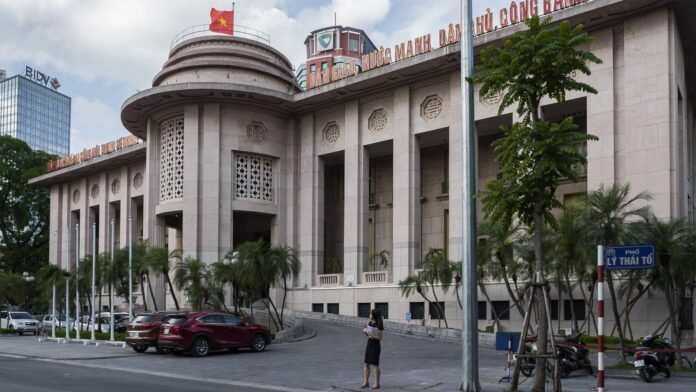
File photo: the State Bank of Vietnam building in Hanoi (June 9, 2017). Photo: Edgardo W. Olivera / Wikimedia Commons, CC BY 2.0. Cropped and resized by The Press of Asia. Archival institutional photograph; it does not show the October 2026 FATF plenary.
What the October plenary decided
FATF’s plenary met in Paris from October 28 to 30 under the UK presidency of Giles Thomson. Its outcome statement addresses virtual assets, scam compounds and country reviews, alongside the updated monitoring lists.
The organisation says Bulgaria, Côte d’Ivoire, the Democratic Republic of the Congo and Monaco have left increased monitoring after completing action plans and successful on-site visits. Vietnam and Myanmar remain in different monitoring categories, with different expectations for financial institutions.
The key distinction at a glance
| Jurisdiction or category | October 30 position | What the statement calls for |
|---|---|---|
| Vietnam | Increased monitoring | Completion of its reform action plan; tangible progress by February 2027 |
| Myanmar | High-risk jurisdiction subject to a call for action | Enhanced due diligence proportionate to risk |
| Iran and DPRK | High-risk jurisdictions | Countermeasures under the relevant FATF statements |
These labels are not interchangeable. FATF says it does not call for enhanced due diligence simply because a country appears on the increased-monitoring list. Its Myanmar statement, by contrast, expressly calls for enhanced due diligence and says this is not a call for countermeasures.
Why Vietnam received a warning
The October increased-monitoring statement says Vietnam’s action-plan deadlines expired in May 2025. It identifies remaining work including risk understanding, international cooperation, supervision, virtual-asset regulation, beneficial-ownership information and stronger financial investigations.
FATF says it will expect tangible improvements in February 2027 or consider next steps. That is a warning about future review, not an announcement that Vietnam has already been moved into the same category as Myanmar or Iran.
For businesses assessing the announcement, the distinction is practical. A future review date creates an implementation question for the authorities and a monitoring question for counterparties. It does not, by itself, identify a new domestic prohibition or cancel a particular transaction.
What the Myanmar category means
FATF’s high-risk statement continues to call for enhanced monitoring of business relationships involving Myanmar, proportionate to the risks. The plenary outcome also highlights concern about fraud and scam activities emanating from the country.
The organisation’s language concerns financial-crime controls and the work still required from the jurisdiction. It should not be used to imply that every person or company from Myanmar is involved in crime. A country-level risk designation is different from an allegation against an individual customer.
For readers sending money or conducting trade, the appropriate next step is to check the applicable law and the actual requirements of the regulated provider handling the transaction. FATF standards, domestic implementation and a bank’s own controls are related but distinct layers; a headline alone cannot establish which documents a particular transfer requires.
Crypto assets, scams and the next milestones
The plenary agreed to accelerate implementation of virtual-asset standards in jurisdictions with materially important activity. FATF says targeted-review results will be published in June and October 2027. It also approved a report on financial flows linked to scam compounds, with publication planned for the following week.
Those are additional workstreams, not evidence that the forthcoming report has already been published or that a named exchange has been found guilty. Readers should look for the actual report, review criteria and subsequent country statements before drawing more specific conclusions.
The main milestones are Vietnam’s February review, the publication of the scam-compounds report and the 2027 virtual-asset review results. Until then, use the exact official category and date when describing a country’s status.
Sources
- FATF: Jurisdictions under Increased Monitoring, October 30, 2026
- FATF: High-Risk Jurisdictions subject to a Call for Action, October 30, 2026
- FATF: Outcomes of the October 28–30, 2026 plenary

The Business Desk covers markets, the economy, companies and personal finance. Stories are checked against at least two credible sources before publication.