SRIHARIKOTA, November 1: ISRO’s GSLV-F18 rocket has placed the NVS-03 navigation satellite into its intended geosynchronous transfer orbit, and the satellite completed its first orbit-raising manoeuvre on October 31, according to a government backgrounder released on Sunday. NVS-03 is the third of five second-generation satellites for NavIC, India’s own satellite navigation system, and its successful orbit-raising matters after the previous satellite, NVS-02, failed to reach its slot last year.
Key highlights
- GSLV-F18 lifted off from the Satish Dhawan Space Centre, Sriharikota, at 23:51 IST on October 30 — the 20th flight of the GSLV.
- NVS-03, weighing about 2,250 kg, was placed in a geosynchronous transfer orbit; its first orbit-raising burn using the Liquid Apogee Motor was completed at 16:48 on October 31.
- The satellite is headed for a geosynchronous slot at 111.75° East.
- It carries L1, L5 and S-band navigation payloads and an indigenously developed atomic clock alongside procured clocks.
- NVS-04 and NVS-05 are in the pipeline.
The mission in numbers
| Item | Detail |
|---|---|
| Launch | October 30, 2026, 23:51 IST, Satish Dhawan Space Centre |
| Rocket | GSLV-F18 (20th GSLV flight); about 50 m tall, about 420 tonnes at lift-off |
| Upper stage | Indigenous cryogenic stage (liquid hydrogen and liquid oxygen) |
| Satellite | NVS-03, about 2,250 kg |
| Initial orbit | Geosynchronous transfer orbit |
| First orbit raising | October 31, 16:48, Liquid Apogee Motor |
| Final slot | Geosynchronous orbit at 111.75° East |
| Payloads | Navigation signals in L1, L5 and S bands |
| Clocks | Indigenous atomic clock plus procured atomic clocks |
Why NavIC needs these satellites
NavIC, formerly the Indian Regional Navigation Satellite System, was designed around seven satellites — three in geostationary orbit and four in inclined geosynchronous orbits — supported by ground stations. It offers an open Standard Positioning Service for civilian users, which works alongside GPS, GLONASS, Galileo and BeiDou, and an encrypted Restricted Service for strategic users. Its coverage spans India and a region extending about 1,500 km beyond its borders.
The second-generation NVS satellites add the L1 frequency, which is widely used by consumer devices such as smartphones, to the older L5 and S-band signals. That makes it easier for everyday receivers to use NavIC, and the series is meant to keep the constellation complete as older satellites age.
The NVS series so far
| Satellite | Launch | Rocket | Status |
|---|---|---|---|
| NVS-01 | May 29, 2023 | GSLV-F12 | Launched successfully; 12-year mission life; indigenous rubidium atomic clock |
| NVS-02 | January 29, 2025 | GSLV-F15 | Could not reach its slot: oxidiser valves failed to open during orbit raising |
| NVS-03 | October 30, 2026 | GSLV-F18 | In transfer orbit; first orbit raising completed |
| NVS-04 and NVS-05 | — | — | In the pipeline |
Our calculation
- Quick start: the first orbit-raising burn came about 17 hours after lift-off (23:51 on October 30 to 16:48 on October 31).
- Gap after a setback: NVS-03 flew about 21 months after NVS-02, whose propulsion problem left it short of its intended orbit.
- Similar spacecraft: at about 2,250 kg, NVS-03 matches NVS-02’s lift-off mass and is close to NVS-01’s 2,232 kg.
What it means
A working NavIC gives India positioning and timing that does not depend on foreign systems — useful for shipping, aviation, disaster management, farming and defence, and for the precise timing that power grids and telecom networks need. The real test for NVS-03 is the next series of orbit-raising burns: after NVS-02’s valve failure, reaching 111.75° East safely is what will count.
What to watch
- ISRO updates on the remaining orbit-raising manoeuvres and arrival at 111.75° East.
- In-orbit testing of the navigation payloads and atomic clocks before the satellite enters service.
- Launch dates for NVS-04 and NVS-05.
- Wider use of NavIC L1 signals in phones and vehicle trackers sold in India.
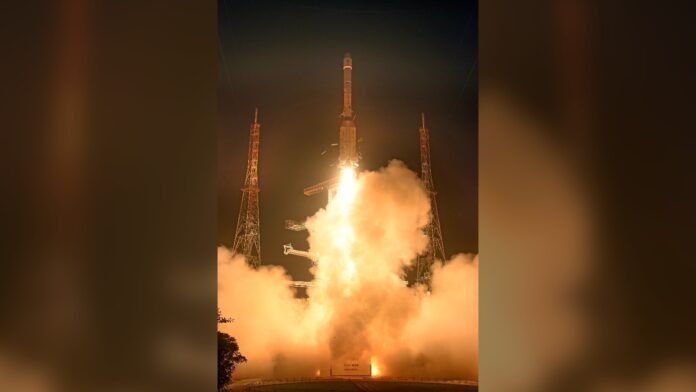
GSLV-F18 lifts off with NVS-03 from the Satish Dhawan Space Centre, Sriharikota, on October 30, 2026. Image: Indian Space Research Organisation (ISRO), used with attribution under ISRO’s terms, via Wikimedia Commons. Photo source · Licence
Sources

The Tech Desk covers technology, artificial intelligence and cybersecurity. Stories are checked against at least two credible sources before publication.