Update: By September 4 the death toll had risen to 12, with 16 still missing, Euronews reported; 239 of the 267 people on board the FiloJet ferry (259 passengers and eight crew) were rescued. The wreck was located at about 550 metres, and the captain and several others were reportedly arrested on charges of negligent homicide. Some reports on September 6–7 put the toll at 14, as the search by Turkish ships and aircraft continued.
Nicosia/Ankara, August 31: At least eight people died and 22 are missing after a passenger ferry capsized off the coast of Kyrenia in northern Cyprus. A multi-agency search and rescue operation that began on Sunday continued into Monday. Officials said about 270 people were on board and 237 have been rescued. Official figures released at different times differed slightly, so the numbers of dead and missing may change.
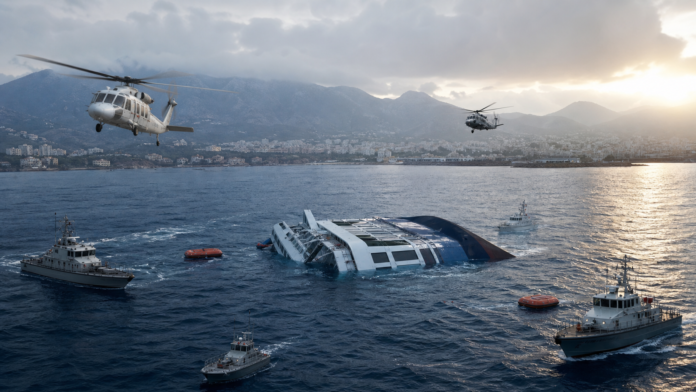
The ferry was sailing from Kyrenia to Taşucu on Turkey’s southern coast. The Turkish Cypriot administration and Turkish rescue teams ran a joint operation at sea with ships and helicopters. Northern Cyprus Prime Minister Ünal Üstel confirmed that 237 people had been rescued, and the Associated Press later put the toll at eight dead and 22 missing.
Key highlights
- At least eight people died and 22 were missing, according to the AP.
- About 270 people were on board; 237 were rescued.
- The ferry left Kyrenia at about 12:30 p.m. local time and soon reported water coming in.
- Turkish and northern Cypriot coast guard vessels, a passenger ship, the Turkish navy and helicopters joined the search.
- The captain and seven others were detained; the cause has not been established.
What happened
According to officials, the ferry left Kyrenia at about 12:30 p.m. local time, and shortly afterwards water was reported entering the vessel. The ship later capsized away from the coast. Passengers were taken onto lifeboats and rescue boats, and some were lifted out by helicopter. Rescued passengers were brought to Kyrenia port and sent to hospitals for medical checks.
According to a statement from Turkey’s interior ministry, published by the Turkish Cypriot news agency TAK, four northern Cypriot coast guard vessels, the passenger ship Akgünler 3, five Turkish coast guard vessels and two helicopters were deployed, and the Turkish navy sent six more maritime assets.
| Measure | Figure | Source |
|---|---|---|
| People on board | About 270 (267 in some counts) | Officials |
| Rescued | 237 | Prime Minister Ünal Üstel |
| Dead | At least 8 | Associated Press |
| Missing | 22 | Associated Press |
| Search assets | 4 northern Cypriot and 5 Turkish coast guard vessels, 1 passenger ship, 2 helicopters, 6 Turkish navy assets | Turkish interior ministry via TAK |
Our calculation: 237 rescued, 8 dead and 22 missing add up to 267, matching the lower count of people on board. That suggests the figures released by different agencies were broadly consistent despite the small differences in timing.
No final conclusion on the cause
The cause of the accident has not yet been settled by an official inquiry. Prime Minister Üstel mentioned bad weather and water entering the ship in his first statement, while Turkish Cypriot leader Tufan Erhürman said no early conclusion about the weather should be drawn from the information available. Given the difference between those statements, it would be wrong to name weather, technical failure, the ship’s stability or human error as the cause for now.
Authorities detained eight people, including the captain. Detention does not mean guilt; investigators may question them about the ship’s condition, passenger list, safety procedures, weather decisions and messages sent before the accident. Voyage records, maintenance documents and communications data will also be important.
The hardest part of the rescue
The first hours matter most in maritime accidents, but a large group of passengers and open-sea conditions make coordination complex. Rescuers must search for survivors, evacuate the injured, identify the dead and reconcile the passenger list at the same time. Officials urged people not to share unverified videos, names or death tolls; official helplines and hospitals are the reliable sources for families. In disasters like this, old ship photos and false passenger lists can spread quickly on social media. Verified lists and local updates also mattered for families during the Nepal flood rescue.
Questions on regional maritime safety
The Kyrenia–Taşucu route is an important regular passenger link between northern Cyprus and Turkey. The investigation will look at whether the ship’s safety certificates, life jackets, lifeboats, capacity limits and pre-departure inspection met the required standards. Any regulatory failure can be confirmed only after a technical report. Only Turkey recognises northern Cyprus as an independent state; the rest of the international community regards the Republic of Cyprus as representing the whole island. Even so, practical coordination in search and rescue is essential to saving lives, and Turkey’s quick deployment gave the operation extra ships and aircraft.
What to watch
- The next official update on the injured and the missing.
- The findings of the investigation, including the ship’s records and inspection history.
- Any charges against those detained.
What it means
The administration declared three days of mourning. For families, the priority is accurate, verified information; for regulators, the question is whether safety checks on a busy passenger route were good enough. For more on disaster and public-safety coverage, see our report on the Indonesia wildfire haze crisis.
This article was first published in Hindi and has been translated. The Press of Asia now publishes in English only.
Sources
- Associated Press: report on the ferry capsizing off northern Cyprus
- TAK (Turkish Cypriot news agency, Turkish): Turkish interior ministry statement on the ferry that capsized off Kyrenia
- MarineLink: Death Toll Rises After Ferry Capsizes Off Cyprus
- Euronews: Death toll from Cyprus ferry sinking rises to 12 as searches continue

The International Desk covers world and Asian affairs, diplomacy and conflict, with a focus on what they mean for India. Stories are checked against at least two credible sources before publication.