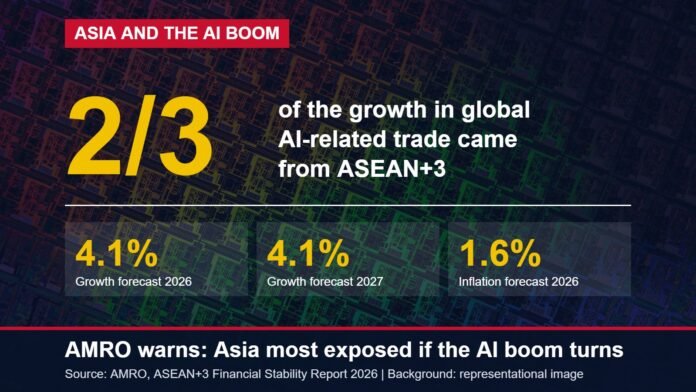
October 5: The economies of Southeast Asia, China, Japan and South Korea would be among the hardest hit if the global boom in artificial intelligence went into reverse, the region’s economic watchdog AMRO warned on Monday. In reports released in Singapore, the ASEAN+3 Macroeconomic Research Office kept its growth forecast for the region at 4.1% for 2026 and raised its 2027 forecast to 4.1%, and said AI-related exports and investment are supporting that growth.
Key highlights
- The reports: The ASEAN+3 Financial Stability Report 2026 and an October update of AMRO’s regional outlook, both released on 5 October.
- Growth: 4.1% in 2026, unchanged from July, and 4.1% in 2027, up 0.1 percentage point.
- Inflation: 1.6% in 2026 and 1.7% in 2027.
- The warning: The report names “high asset concentration in AI” as a risk that could open “new sources and channels of financial stress”.
- Country changes: Malaysia’s 2026 forecast was raised to 5.1%. The Philippines’ forecast was cut.
What AMRO said
AMRO said the region’s financial markets and banking systems have stayed “broadly resilient” through a year shaped by the Middle East conflict on one side and strong optimism about AI on the other. Banks are well capitalised and foreign exchange reserves are adequate, it said.
“The AI investment cycle is supporting a widening range of regional activities, although domestic demand remains uneven,” AMRO’s chief economist Dong He said in the organisation’s statement.
The same statement says the growth outlook is particularly sensitive to AI-related demand, and that a sharp repricing of AI-related assets could set off broader market corrections. Other risks on AMRO’s list are US dollar volatility, leverage among non-bank lenders, the spread of digital finance and cyber threats.
How a reversal would reach Asia
The fullest account of the AI section comes from Bloomberg, whose report was carried by The Edge Malaysia. It says the report finds that the region accounted for two-thirds of the growth in global AI-related trade, and that a downturn would arrive through four channels: lower technology exports, portfolio losses, capital outflows and refinancing pressure on indebted technology and infrastructure companies.
According to that account, South Korea is exposed through memory chips and a stock market heavily concentrated in AI shares, Malaysia through semiconductor assembly, and Japan and Hong Kong through markets that move closely with US technology stocks. The report also points to rising debt at the large cloud companies that are funding data centres, and to private credit and circular financing deals that could make a correction worse. The Bank of England and the Monetary Authority of Singapore have raised similar questions, Bloomberg noted.
The forecasts
| Forecast | 2026 | 2027 |
|---|---|---|
| ASEAN+3 growth | 4.1% (unchanged from July) | 4.1% (up 0.1 point) |
| ASEAN+3 inflation | 1.6% | 1.7% (up 0.1 point) |
| Malaysia growth | 5.1% (was 4.9%) | 4.8% (was 4.7%) |
| Malaysia inflation | 2.0% (unchanged) | 2.2% (was 2.0%) |
Sources: AMRO for the regional figures; Bernama, carried by The Star, for Malaysia.
On Malaysia, Dong He said that “what is important in this kind of environment is for these gains to be broadly propagated towards the economy”, Bernama reported.
The Philippines moved the other way. AMRO cut its 2026 growth forecast for the country to 3.3% and pointed to the energy shock and weak investment, according to the headlines of reports in Manila Bulletin and BusinessWorld. We could not open either report in full, so no further detail is given here.
Energy and the Strait of Hormuz
AMRO said shipping disruptions in the Strait of Hormuz pushed up energy prices and lifted its inflation forecasts, but that disruptions to energy supplies and industrial inputs “proved less severe than many had feared”. It still lists renewed energy disruption in the Middle East among the main risks to its forecast. That risk has not gone away: the United States is sending a third aircraft carrier towards the region, and the G7 has agreed to release 100 million barrels from emergency reserves.
What AMRO wants governments to do
- Keep financial buffers and policy credibility intact.
- Deepen domestic financial markets.
- Watch the whole financial system, including non-bank lenders, and not only banks.
- Share more information across the region and prepare jointly for a crisis.
Analysis: one engine, one main risk
Analysis by the Business Desk. The unusual feature of this year’s reports is that AI demand is both the reason for the upgrade and the first item on the list of things that could go wrong. Economies that make the hardware, such as South Korea and Malaysia, gain the most while orders last and are the most exposed if they stop. AMRO’s own answer is not to step back from the boom but to make sure banks, non-bank lenders and reserves could absorb a sudden fall. Governments in the region are also competing for a place in the AI economy, as Kazakhstan’s recent push shows.
References
- AMRO: ASEAN+3 Financial Stability Report 2026
- AMRO press release: ASEAN+3: Navigating Shocks Through Stronger Foundations and Deeper Financial Integration
- Bloomberg via The Edge Malaysia: Asia among most vulnerable to AI correction, Asean unit warns
- Bernama via The Star: AMRO upgrades Malaysia’s 2026, 2027 growth forecasts as AI investment boosts economy
- Manila Bulletin (headline only): AMRO slashes Philippine 2026 growth forecast to 3.3% as inflation stays high
- BusinessWorld (headline only): AMRO slashes Philippine growth forecasts on energy shock, investment woes

The Business Desk covers markets, the economy, companies and personal finance. Stories are checked against at least two credible sources before publication.