
November 2: Indonesia’s manufacturing sector strengthened in October, with the S&P Global Manufacturing Purchasing Managers’ Index rising to 54.0 from 52.4 in September. The November 2 release reported the fastest expansion in production since March 2024 and the strongest increase in new export orders since that series began in April 2011. However, hiring remained modest and manufacturers faced faster increases in input costs.
Key highlights
- The headline PMI rose by 1.6 index points to 54.0.
- New export orders increased at the fastest rate in the survey’s history.
- Purchasing and input inventories expanded, while finished-goods stocks were drawn down.
- Employment grew only marginally, even as demand and output strengthened.
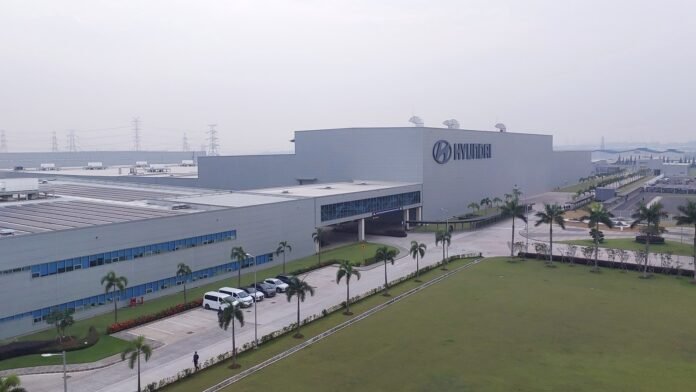
File photo: Hyundai Motor Manufacturing Indonesia (July 1, 2023). Credit: AWG97 / Wikimedia Commons, CC BY-SA 4.0. Cropped and resized by The Press of Asia. The photograph illustrates Indonesian manufacturing; it does not identify the plant as a PMI respondent or show its October 2026 performance. This adaptation is shared under the same licence.
What changed in October
The latest survey linked the improvement to stronger demand for Indonesian manufactured products. New orders rose for a third consecutive month, with the fastest increase since October 2021. Respondents cited improving customer confidence and new product introductions. Production expanded for a second month as firms sought to meet those orders.
Companies also used existing finished-goods stocks to fulfil incoming business. That is an important part of the picture: a busy order book does not always translate immediately into the same increase in fresh production. Inventory drawdowns can help bridge the gap while factories adjust purchasing, staffing and production schedules.
At a glance
| Item | Confirmed detail | Why it matters |
|---|---|---|
| Headline PMI | 54.0, up from 52.4 | Stronger improvement in operating conditions |
| Reference month | October 2026 | Published November 2, not a November activity result |
| Export orders | Fastest growth since the series began in April 2011 | A survey record, not a record customs export value |
| Bank Indonesia context | Q3 PMI-BI: 52.28%; Q4 expectation: 52.37% | Separate quarterly evidence and a forward-looking estimate |
An export signal, not a customs total
S&P Global’s export-orders finding refers to the pace of change reported by surveyed companies. It does not mean Indonesia has just recorded its highest-ever dollar value of manufactured exports. A diffusion index captures the balance of respondents reporting increases, decreases or no change; customs statistics measure a different thing.
Our calculation: the headline index rose 1.6 points, from 52.4 to 54.0. This is an index-point change, not a 1.6% increase in factory output. Reading it correctly matters for businesses deciding whether to expand orders, inventories or transport capacity.
For regional suppliers, a stronger Indonesian order pipeline may create opportunities in materials, components and logistics. That is an implication of the survey findings, rather than an announced contract or evidence of sales for any named business. Buyers should still assess actual order books, payment terms and delivery commitments.
Why employment and costs deserve equal attention
Despite the stronger activity, the survey reported only marginal job creation, at a slower pace than in September. Outstanding work increased, pointing to continuing capacity pressure. The immediate growth signal is consequently stronger than the employment signal; the release cannot be treated as evidence of a rapid nationwide expansion in manufacturing jobs.
Input cost inflation accelerated, and manufacturers increased selling charges at a faster pace. This differs from a situation in which factories expand primarily by discounting. For customers, the relevant question is whether stronger demand allows suppliers to pass through costs and whether those increases persist beyond a single month.
The report also described a renewed improvement in supplier delivery times. Faster deliveries can help factories rebuild input inventories and reduce disruption, but the national survey does not establish conditions on a specific shipping lane. Supplier reliability needs to be checked against the buyer’s actual products and routes.
How the central bank’s survey fits
Bank Indonesia’s separate October 19 release had already reported an improving manufacturing picture in the third quarter. Its Prompt Manufacturing Index rose to 52.28% from 51.43% in the previous quarter, with respondents expecting 52.37% for the fourth quarter. Those figures provide independent institutional context, but they cover different periods and a different survey framework.
The central bank’s fourth-quarter figure is an expectation, not a completed-quarter result. It should not be averaged with S&P Global’s October reading or presented as a second measurement of the same month. The useful common signal is that both releases described expansion in their respective observation periods.
What to watch
Future production and export statistics will help establish whether the order improvement translates into sustained shipments. Employment, costs and delivery times will show whether factories can increase output without creating wider bottlenecks. November’s survey will provide the next monthly comparison.
For now, the evidence supports a stronger start to the final quarter, with the export-order component particularly notable. It also sets a clear limit on the headline: demand is improving faster than hiring, and rising costs mean stronger sales do not automatically produce a matching increase in profits.
Sources
- S&P Global: Indonesia manufacturing output rises at fastest pace since March 2024
- Bank Indonesia: Manufacturing industry performance increasing in Q3 2026

The Business Desk covers markets, the economy, companies and personal finance. Stories are checked against at least two credible sources before publication.