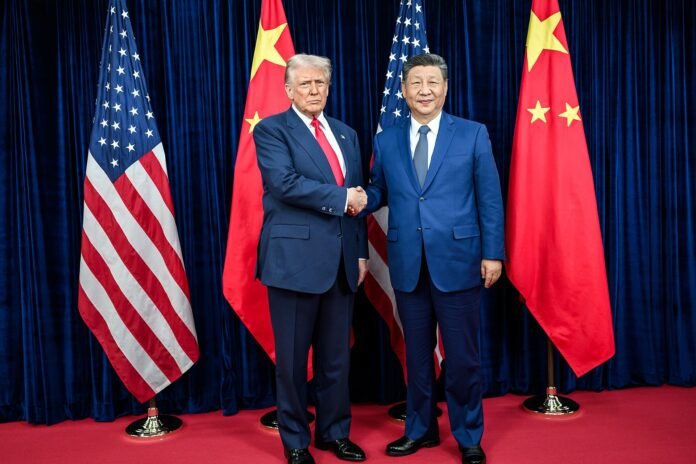
Washington, September 26: Chinese President Xi Jinping’s three-day state visit to the United States ended on Friday with tea at the White House and a tour of the National Archives — and with a narrow trade package rather than the “big deal” some had hoped for. The two sides agreed to shield farm goods and medical devices from their trade fight and to keep talking on artificial intelligence, but left Taiwan, chip export controls and rare earths unresolved.
Key highlights
- Xi’s state visit ran from September 23 to 25; President Donald Trump greeted him on arrival at Joint Base Andrews.
- Before the talks, Treasury Secretary Scott Bessent said the tariff truce agreed in Busan last October would be extended from November 10, 2026 to January 10, 2027.
- The summit produced a limited agreement covering US agricultural products and medical devices; US Trade Representative Jamieson Greer is due to publish details on Monday.
- Taiwan and US arms sales, semiconductor export controls, rare-earth exports and China’s support for Iran were not resolved.
- The leaders are expected to meet again at the APEC forum in China in November and the G20 summit in Miami in December.
What was agreed
The most concrete outcome came even before the leaders sat down. On September 24, Bessent said Washington and Beijing would extend the “Busan agreement” to January 10 “to give us more time” for economic talks. That truce, first struck when Trump and Xi met in Busan, South Korea, in October 2025, suspended some tariff increases, eased China’s curbs on rare-earth exports and paused fees on Chinese ships at US ports.
At the summit itself, the two governments agreed to treat agricultural products and medical devices separately from the wider tariff dispute. Trump told reporters that “our farmers are going to be happy”, but did not give numbers. The full text is expected from the US Trade Representative’s office on Monday.
Both sides also agreed to continue a dialogue on artificial intelligence, a topic that has moved up the agenda this year as the two countries compete on advanced chips and models.
What was left open
The list of unresolved issues is longer than the list of agreements. There was no reported progress on Taiwan and US arms sales to the island, American controls on advanced chip exports, Chinese rare-earth export restrictions, or Beijing’s economic support for Iran — an issue that has gained weight as the US-Iran conflict keeps oil prices above $100 a barrel.
Xi described the relationship as having reached “strategic stability” built on mutual respect. US Ambassador to China David Perdue put it more modestly, saying the best thing the visit achieved was to keep the conversation going.
The farm question
American farmers were watching closely. Under earlier commitments, China agreed to buy 25 million metric tonnes of US soybeans a year from 2026 to 2028, plus about $17 billion of other farm products, S&P Global reported. Bessent said China had been “very good” on soybeans but was “a little behind schedule” on the other purchases.
US soybeans still face a combined 13% Chinese import duty (a 10% reciprocal tariff plus the 3% most-favoured-nation rate), while Brazilian soybeans pay only 3%. Farm groups wanted “something measurable” from the summit; beforehand, a new agricultural win had looked unlikely.
Why it matters for India and Asia
- Stability, not reset: the extension to January removes the risk of a sudden tariff jump in November, which would have hit Asian supply chains that feed both economies.
- Chips stay contested: with export controls unresolved, the push to move electronics and chip production to countries such as India continues — see our report on Alibaba’s Zhenwu V900 AI chip for how China is building its own alternatives.
- Taiwan risk unchanged: no progress on Taiwan means the Taiwan Strait remains a key risk for Asian markets and shipping.
- Oil and Iran: China’s ties with Iran remain a point of friction at a time when crude prices are straining import-dependent economies like India.
Background
Xi’s trip reciprocated Trump’s state visit to Beijing in May. For our earlier coverage, read what was confirmed before Xi’s visit and how the trade truce was extended to January 10, 2027.
What happens next
- Monday: USTR Jamieson Greer is expected to publish details of the farm and medical-device arrangement.
- November: the leaders are expected to meet again at the APEC forum in China.
- December: the G20 summit in Miami offers another meeting.
- January 10, 2027: the extended truce expires unless a wider deal is reached or it is extended again.
Sources / References
- S&P Global Commodity Insights: “US says trade truce with China extended till Jan. 10, 2027, ahead of Trump-Xi meet”
- Farm Policy News, University of Illinois: “US & China extend trade truce until January as Xi arrives in US”

The International Desk covers world and Asian affairs, diplomacy and conflict, with a focus on what they mean for India. Stories are checked against at least two credible sources before publication.