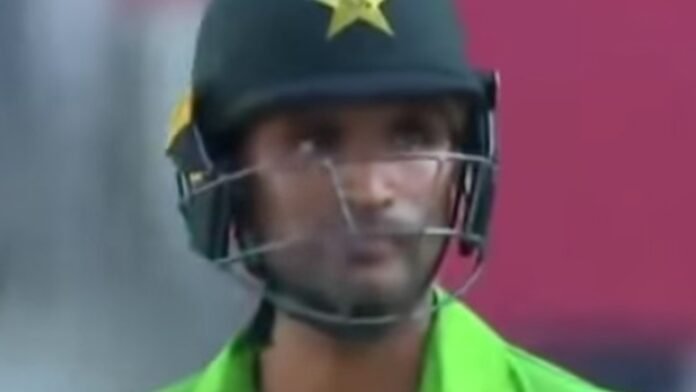
November 2: Fakhar Zaman has reflected on Pakistan’s title-winning performance after his century helped the hosts chase 326 against Sri Lanka in the ODI tri-series final in Lahore on October 31. A Pakistan Cricket Board interview published on November 1 highlighted his approach under pressure and the contributions of younger teammates. The match itself ended with Pakistan 331/7 in 48.3 overs, a three-wicket win with nine balls remaining, according to the PCB score summary.
Key highlights
- The final was played on October 31; the follow-up PCB interview appeared November 1.
- Fakhar scored 127 from 99 balls, with Saad Baig contributing 74.
- Arafat Minhas made 61 from 31 deliveries in the decisive late partnership.
- Sri Lanka’s 325/8 included Kamindu Mendis’s 131 and Pavan Rathnayake’s 77.
File photo: Fakhar Zaman batting during Pakistan’s 2017 series against Sri Lanka (2017). Credit: Pakistan Cricket Board / Wikimedia Commons, CC BY 3.0. Cropped and resized by The Press of Asia. A licensed frame from archival PCB footage, not the October 31, 2026 final.
How Pakistan recovered from the early wickets
The ICC’s match report describes an early setback as Maaz Sadaqat and Babar Azam departed cheaply. Fakhar and Saad then rebuilt the chase rather than allow the target to dictate a reckless response. PCB’s report records a 149-run partnership between them, with Saad reaching his first ODI fifty.
Fakhar’s 127 was his twelfth ODI century. Saad’s 74 from 75 balls supplied both support and scoring momentum, allowing Pakistan to recover without asking one batter to do all the work. Their partnership was the bridge between the early loss of wickets and the late acceleration that ultimately decided the final.
At a glance
| Item | Confirmed detail | Why it matters |
|---|---|---|
| Venue and date | Gaddafi Stadium, Lahore; October 31, 2026 | The final’s date is distinct from the follow-up interview |
| Sri Lanka | 325/8 in 50 overs | Kamindu Mendis 131; Pavan Rathnayake 77 |
| Pakistan | 331/7 in 48.3 overs | Won by three wickets with nine balls remaining |
| Key Pakistan scores | Fakhar 127; Saad 74; Arafat 61 | Recovery and acceleration came from different partnerships |
Why the late partnership was decisive
Sri Lanka regained an opening when Pakistan fell to 230/5. With the target still some distance away, Hasan Nawaz and Arafat Minhas added 94 for the sixth wicket, according to PCB. Arafat’s 61 from 31 balls changed the pace of the chase, while Hasan contributed an unbeaten 37 from 45.
Our calculation: 61 runs from 31 deliveries gives Arafat a strike rate of approximately 196.8, using runs divided by balls and multiplied by 100. This measures the speed of that innings, not his career strike rate. It helps explain why his contribution mattered beyond the raw total of runs.
The ICC records that captain Shaheen Afridi completed the chase with a six. Pakistan’s final score consequently exceeded the target, which is normal when the winning stroke is a boundary. The match was not tied at 326, and 48.3 overs means 48 overs and three balls, not 48.3 decimal overs.
Sri Lanka’s batting effort still deserves attention
Kamindu Mendis’s 131 from 128 balls and Pavan Rathnayake’s 77 from 65 formed the core of Sri Lanka’s innings. The ICC reported an 87-run opening partnership between Kamindu and Avishka Fernando before the innings developed around the middle-order stand.
PCB’s score summary lists Sri Lanka at 325/8 after 50 overs, with Salman Ali Agha, Shaheen, Haris Rauf and Naseem Shah taking two wickets each. For Pakistan, the result is evidence of a successful chase, but conceding that total remains part of the performance assessment. Winning the final does not remove the bowling and fielding questions a team may still want to address.
For Sri Lanka, a substantial total and a century from an opener are positive elements within a defeat. The more immediate review concerns how Pakistan were allowed to rebuild after early wickets and then accelerate after the fifth wicket. The available reports establish the partnerships; they do not establish private dressing-room assessments or a specific tactical error by an individual player.
What Fakhar said after the title
PCB’s November 1 account of his interview says he discussed adapting his attacking game to the match situation, building a partnership with Saad and backing emerging players. It also says he addressed the role of captain and team management in supporting players through difficult periods. This article paraphrases that published account rather than presenting an invented verbatim quotation.
That follow-up offers useful context for a team preparing for the 2027 ODI World Cup. The final supplied contributions from an experienced opener, a young wicketkeeper-batter and an emerging all-rounder. It is a stronger preparation signal than a victory dependent on one isolated innings, although one final cannot predict performance at the World Cup.
What to watch
The next measure is whether Pakistan can reproduce this balance consistently: a reliable opening platform, recovery partnerships when wickets fall, and a lower order capable of maintaining the required rate. Sri Lanka will be looking for a way to turn strong batting positions into wins against high-quality chasing sides.
The result remains an October 31 final, not a new match played on November 2. The fresh element is the post-title reflection and what the scorecard reveals about Pakistan’s developing batting options. Those distinctions keep the follow-up separate from a misleading claim of another result today.
Sources
- Pakistan Cricket Board: Fakhar’s 127 and Arafat’s 31-ball 61 lead Pakistan to tri-series title
- ICC: Pakistan clinch tri-series with big chase against Sri Lanka
- Pakistan Cricket Board: Fakhar Zaman reflects on match-winning century

The Sports Desk covers cricket, the Asian Games and Indian and international sport. Stories are checked against at least two credible sources before publication.